I Don’t Trust a 100% Guarantee

… part of my walking-talking manifesto in progress, on the theme of I Hate Positive Thinking…


One meaning of ‘positive’ is 100% certain.

 I AM POSITIVE THAT THE THING I OFFER WILL HELP YOU.

 I guarantee if you use this system you’ll have massive breakthroughs in the next month.

 You’ll be making six figures in no time if you take these three steps. I promise.

 If you’re experiencing [random thing], I can guarantee that the problem is [something I can solve].

I’ve come to realize that I never trust anyone who 100% guarantees a result.
the power of positive thinking

To me, it’s an automatic bullshit detector. But it’s hard to avoid, because it’s tied in to the language of buying and selling. And because coaches and practitioners and healers are offering something intangible – a service, not a product – there is a temptation to make it feel more tangible by guaranteeing results.

5d7

This is one of the reasons I avoided entering this field for so long: I can’t stand seeing the realm of the unconscious reduced to being bought and sold like a product.

But can you be successful without doing that? This recovering life coach thinks you can’t, but I’m hoping you can. I’m heartened to see examples of coaches, counselors and mavens who offer great services without false guarantees or manipulation disguised as positive thinking.

And I think, if their honesty and humanity and humility is something that attracts me, then it can attract people to me too.

Because I think most of us would rather hang out with someone who’s being honest and real than giving us a line we want to hear.

So I’m not going to tell you that my approach is 100% GUARANTEED.

I’m not even going to tell you I have a foolproof, rock solid “approach,” as if it were a product I hammered out that sits on the shelf, gleaming and perfect. Nope.

What I have is a way in, based on years of working creatively with my own mind and body, and with other people. It is born out of the particulars of my circumstances – particulars that I think a lot of people share. It works for me, and it works for other people. But it is constantly evolving and doesn’t exist in a vacuum.

I could give you a pencil and the chances that you’d write something with it are high, but I have no idea. Maybe you’ll chew it. Maybe you’ll draw on the table. Maybe you’ll throw it across the room. Maybe you’ll break it into tiny pieces and fashion a miniature beaver dam.

high_242

The possibilities are endless, and that’s what I love about this work.

I give you tools, show you how to use them, and guide you through the process. Then you do the work, and see what arises. If you have a breakthrough, it comes from you and your life, your passion, your abilities – not some magic pill I conjured up for you.

That’s what I offer. A process that grows and changes depending on who is using it, when they use it, and how they use it. A process that I think is kick-ass, and which usually leads to insights, aha moments and shifts in perspective. It’s like a chemistry experiment: powerful things are bound to happen, but it’s impossible to predict exactly what.

That’s why we experiment: to find out what will happen. No guarantees, no promises, no bullshit.


Want to work on your own manifesto? Come to my free workshop on June 14! 
Living in an alternate world

I am a big fan of speculative fiction — and I could easily write a long, long post about the rabbit hole of internet fascinations that appear when you google that term — but long story short, it’s because books and films and television set in another world or time give us a chance to step out of our actual lives and engage our imaginations. When we do that, we open up to possibilities in our present, actual world that we could not see before.

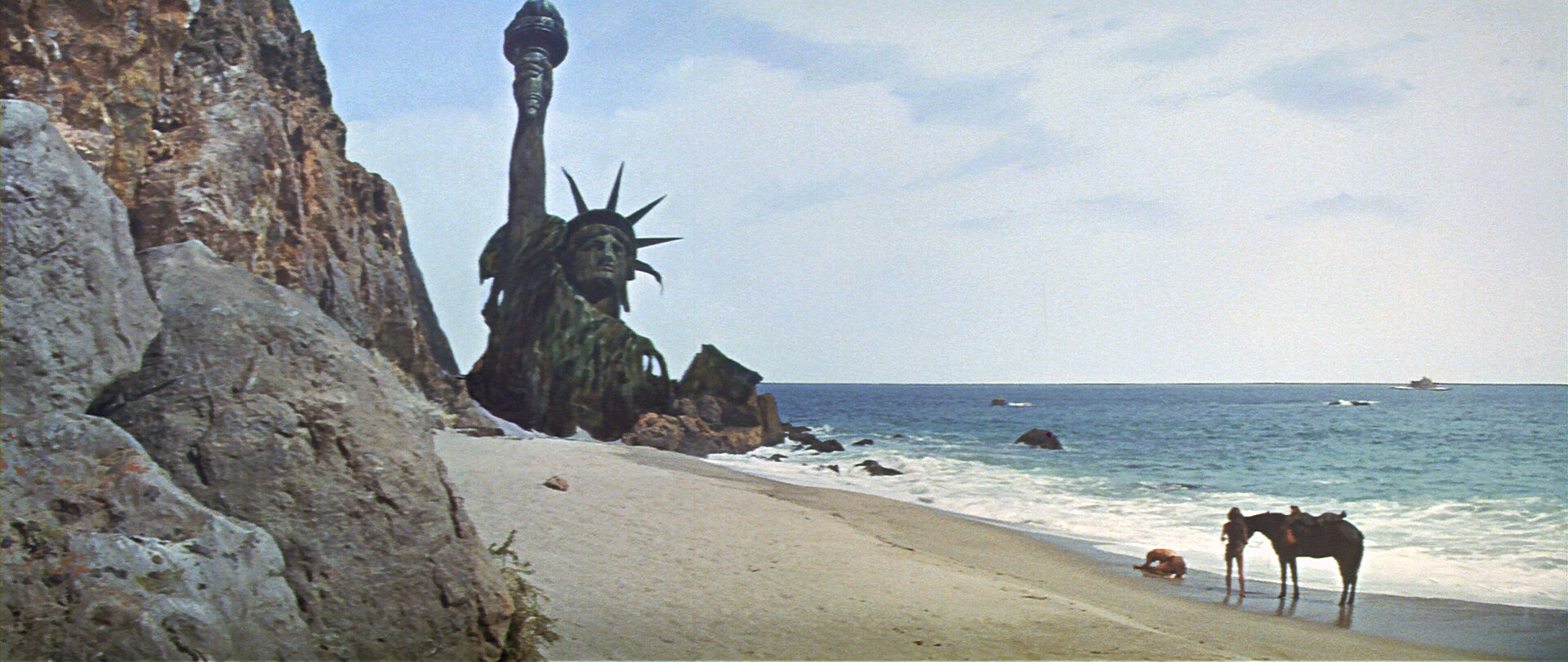
“God damn you all to hell!”

Or, as TV Tropes eloquently puts it:

One of the greatest strengths of Sci-Fi and Fantasy is that they can convey real-life situations in a new context by showing everyday problems, humanity’s greatest challenges, and even social commentary that’s ostensibly free of the prejudices and preconceptions that weigh them down in Real Life, giving us a more detached view of a given problem… as if we were aliens visiting Earth, or rather Earthlings visiting World of Weirdness.

In a way, it’s similar to why I got into acting when I was a kid. I was shy, but when I stepped onstage I could step into another persona (for instance: this one), and access parts of myself that had previously been unknown. That’s something any actor does: they put on a costume and do their hair and step into a heightened space, and become someone else for a while. I think this is something we could all benefit from doing.

In fact, we all do it a little bit: we get a radical haircut to jumpstart a big change in life, we apply darker, bolder makeup for going out at night, or we step into one persona for work, and then another one when we get home and change out of our work clothes.

I thought it would be fun to take this a step further, to stretch our brains and bodies and see what might be hanging around in our unconscious. So on Sunday I’m leading a workshop exploring alternate worlds and alternate lives. We’ll draw pictures of our alter egos, imagine our superhero and supervillain selves (and more importantly, their outfits), recreate/revise a seminal moment from our past, create a new world, and apply sci fi tropes like “gone horribly right” or “the [adjectival] man” to our personal lives.

the_invisible_man_by_stevedore

I am very curious to find out what happens. It raises so many questions and I can’t wait to see how we answer them on our feet: if you could invent a new world, what would it look like? What keeps us from inventing that world now? What can you learn by embodying your opposite self? What can you learn by embodying your worst or best traits, by taking them to their furthest extreme? If you changed one thing in your past, what else might change?

Come by and find out with me! Details are here.

How to Fail, part 2

We had our workshop last Sunday and it was a great success. Meaning, we failed fantastically. Here are some of the things we did – and good news, you can try these at home.

WORST FEET FORWARD

We picked our least favorite body part, and instead of hiding it, we drew attention to it. (Interestingly, for most people the body part of choice was their belly. I know for me, it felt cathartic to stick my belly out instead of sucking it in, to take pride in its softness). Try this when you’re walking around your house by yourself – emphasize the body part you usually hide, and see how it feels to show it off.

I APOLOGIZE

We apologized to the group for everything we had done wrong this week, big or small.

I think this exercise is especially powerful for the ladies. If you’re a strong, smart woman, I bet you spend a lot of energy stopping yourself from apologizing. It’s good to stem the tide of reflexive apology, but it’s also nice to give yourself room to go the other way. Clearly we have a great need to apologize, so why not get it out of the way? Apologize for everything, even if it’s not your fault! Apologize profusely, apologize way too much, apologize from the bottom of your heart.

To do this on your own, try this: get some paper and write down everything you did wrong this week. Made the coffee too weak? Forgot to call your Mom back? Snapped at your partner? Felt like the vibe at work was weird and maybe it was because of something you did? Write it all down. You can use this format if it helps:

I apologize for _____.

I [wasn’t thinking / didn’t prepare / got angry…] and I [messed up / bungled the presentation / hurt your feelings…].

I apologize about that.  

When you’ve filled up a page, read them out loud. Add in “I am so, so, so, so sorry” or “please forgive me” when/if appropriate.   Then rip it out and throw it away. You’re done! Apology accepted.

BAD POETRY

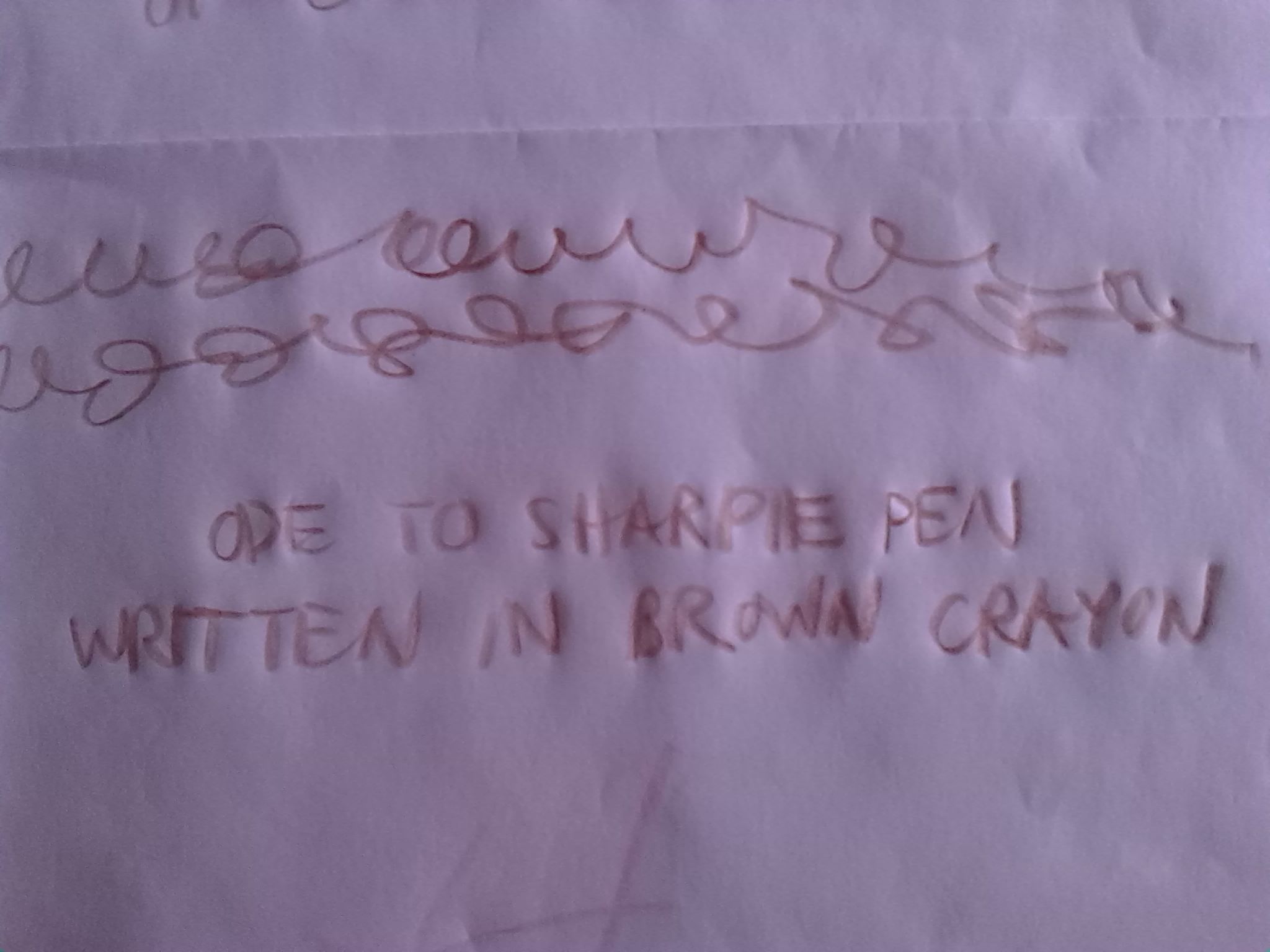
We wrote bad poetry, which included odes to phlegm, folding chairs, red leather chaps and the winning entry:

IMG_20150406_141935

If you want to write bad poetry, it’s easy: pick a thing (could be something abstract like love, or mundane like a granola bar). Write ODE TO [THING] at the top of a sheet of paper. Now write the worst poem you can about that thing.

Some techniques to try: bad rhymes, going on way too long or not long enough, stating the obvious, reveling in self-indulgence, making bad jokes, using “I” as much as possible, dragging a metaphor into the ground… there are SO MANY WAYS! Start and find out what your personal worst is.

BIG PROBLEMS / STUPID SOLUTIONS

We brainstormed stupid solutions to big problems, like racism, climate change and feeding hungry kids.

IMG_20150406_142052 (1)

You can try this too, with either a big global problem or a problem in your life. Pick the problem, set the timer for 5 minutes, and come up with as many dumb solutions as you can.

Here’s an example from my life: a problem I’m experiencing lately is how to get my 19-month-old son to sleep at night. Here are some stupid solutions:

  • I could write a 5-page essay on the merits of sleep and read it aloud to my son
  • I could perform an interpretive dance every night called “Bed Time”
  • I could walk outside in the middle of the night and cry to the heavens, “WHY?!!!!”
  • When he wakes up in the middle of the night, I could just cry with him
  • I could give him a shot of whiskey [remember, these are STUPID solutions, not things I would actually do!]
  • I could play him these ‘power of positive thinking’ tapes someone gave me
  • I could find a boring financial podcast and play that on repeat
  • I could post a question about it on facebook [full disclosure, I know this is a stupid solution because I have done it]
  • I could make flyers that say HELP ME GET MY SON TO SLEEP and post them around town with my phone number

You get the idea.

FALLING

We practiced falling, and then practiced doing a big confident walk across the room with a spectacular fall in the middle.

If you want to fall right, here’s how: count to ten, and do a slow motion fall so you’re on the ground by the time you get to ten. Then count back from ten to one, and get back up on your feet in slow motion.

Do it again, but with a five-count. Now do it to a count of 3. Look at that! You’re falling!

BAD ELEVATOR SPEECH

We ended the workshop with super awkward, meandering, oddly confrontational elevator speeches.

Want to try? Imagine someone you deeply want to impress. Someone you would love to meet and get a chance to talk to – maybe it’s a leader in your field, or the boss of your boss, or the hot guy you keep seeing around town.

Now imagine that you walk into an elevator in a building, and GET OUT OF TOWN. They are standing right there. Now is your chance!

Imagine what you would like to say to them in the two minutes you have in the elevator – the words you would use, the way your body would move, how they’d look at you.

Now stand in front of a mirror, and do the opposite of that.

Say exactly what you would NOT like to say, using words that you would not like to use, doing things with your body that are embarrassing or awkward or weird, and imagine their face looking back at you in horror.

Bonus round: do your best confident walk, and say the best version of your elevator speech, but halfway through launch your spectacular fall.

There! Doesn’t it feel good to get all that out of your system?


Hey! Want to work some of these ideas out in person? I’m available to do one-on-one sessions, or you can hire me to lead a workshop for your organization!

On not praising, not giving advice, and drawing your feelings

I’ve been reading the book How to Talk So Kids Will Listen & Listen So Kids Will Talk in preparation for the approach of (duh duh DUHHHHH) the toddler state.

IMG_20150218_171723

What, me tantrum?

It’s a fantastic book, and what’s fascinating is how much of their advice about how to communicate with kids applies just as well to adults.

In particular, these three techniques struck me – I notice myself using them in sessions as a creative guide, and I think they are wonderful tools we can all use to communicate better.

1) Unhelpful vs. helpful praise

As they put it, “praise can be tricky business. Sometimes the most well-meant praise brings about unexpected reactions.”

In particular, these reactions:

  • Praise can make you doubt the praiser.
  • Praise can lead to immediate denial.
  • Praise can be threatening.
  • Praise can force you to focus on your weaknesses.
  • Praise can create anxiety and interfere with activity.
  • Praise can also be experienced as manipulation.

What works far better is “helpful praise”, which is descriptive rather than evaluative.

“If you describe with appreciation what you see or feel, the child, after hearing the description, is then able to praise himself.”

The problem with words that evaluate – good, beautiful, smart, awesome – is that they draw attention to your judgment as the praiser, instead of the person or thing you’re praising.

So if I say, Wow, what a beautiful painting, you are likely to think, She’s bullshitting me, or Jeez, she thinks that’s beautiful? or I don’t think it’s beautiful at all, or What’s she going to think of the next one… etc etc etc. But you are not likely to think, My painting is in fact beautiful.

On the other hand, if I focus on what I see and feel in response to the painting, you can decide for yourself what to do with that information.

I could say, I see a lot of color in this painting. Or, This painting reminds me of a field I used to run in as a kid. Or, I love the way the paint is layered on the canvas.

Do you see the difference? One is an evaluation and stops the conversation – one opens the door to a larger conversation that is much more interesting than good job/bad job.

2) The futility of giving advice

“When you give immediate advice to children, they either feel stupid (‘Why didn’t I think of that myself?’), resentful (‘Don’t tell me how to run my life!’), or irritated (‘What makes you think I didn’t think of that already?’). When a child figures out for herself what she wants to do, she grows in confidence and is willing to assume responsibility for her decision.”

I think the exact same thing is true of adults. And what they recommend doing instead is this:

  • Help her sort out her tangled thoughts and feelings.
  • Restate the problem as a question. (They also suggest that you “keep quiet after you’ve asked a question like this. Your silence provides the soil in which the child’s solutions can grow.”)
  • Point out resources your child can use outside the home.

The more I think about it, this book is basically a manual for being a Creative Guide. I can’t think of a better description for how I work with people than those three things.

3) The usefulness of drawing your feelings

“… the one activity that seems most comfortable for parents to watch, and most satisfying for children to do, is to draw their feelings.”

They describe this scene between a mother and her 3-year-old:

“’I knelt down, handed the pencil and pad to Joshua, and said, ‘Here, show me how angry you are. Draw me a picture of the way you feel.’ Joshua jumped up immediately and began to draw angry circles. Then he showed it to me and said, ‘This is how angry I am!’

I said, ‘You really are angry!’ and tore another piece of paper from the pad. ‘Show me more,’ I said…. When I handed him a fourth piece of paper, he was definitely calmer. He looked at it a long time. ‘now I show my happy feelings,’ he said.

How interesting that we as adults would rarely think of doing this!

Can you imagine? Next time you and your partner / mother / best friend / co-worker get into a fight, imagine saying this:

Hey, partner.

You seem frustrated. Can you draw your feelings for me?

Wow, that IS frustrating!

I am frustrated too, can I draw what I’m feeling for you?

I am going to start using this as a conflict resolution tool and see if it works! I’ll report back, and if you try it, let me know how it goes.

I also love the cartoons in the book to demonstrate what to do and not to do, like this:

Creative Workout: in progress

We’ve had two sessions of the Creative Workout Group and I have to say, so far it’s been hilarious and brilliant and awkward in the best sense. What a brave and beautiful group of people.

  • We’ve felt our own heartbeats, and felt someone else’s heartbeat.
  • We’ve danced like we’re 9 years old and like we’re 90.
  • We’ve made fart noises while making intense eye contact, which never fails to make me laugh until I cry.
  • We’ve come up with alias names and power words.
  • We’ve shared what fascinates us and what frustrates us.
  • We’ve drawn spirals with our eyes closed to see what words and images come to mind when we think of a project.
  • We’ve described a project to someone else using only our eyes.
  • We’ve shared what we thought someone else’s project was (based on what their eyes told us).
  • We’ve come up with catchphrases / mantras / slogans (I don’t like any of these words, can we do a word association exercise to come up with a better one? And don’t suggest ‘branding’) to describe our projects.

There are some pretty incredible projects, and next week people will get to share them using words (not just their eyes). I can’t wait!

Who is this for?

I’m pretty excited about the new Creative Workout Group I’ll be leading starting next week (there are still spots if you want to sign up!). As I’ve been talking to people about it, I’ve been getting these questions:

Do you have to be an artist to be in the group?
Do you need to have a project you’re working on?
Who is this for?

So I thought I should spell out who this is for — “this” being the group, and the sessions I am doing with individual clients.

This is for you if you:

  • are going through a transition
  • are feeling lost or stuck or stranded
  • are in the grips of a life crisis (midlife, quarterlife or otherwise)
  • are starting a project (and by ‘project’ I mean anything from writing a book to starting a business to having a child to taking your show on the road – anything big that you want to do)
  • are lost in the middle of a project, or 90% done and roadblocked
  • are trying to decide between 10 potential projects
  • are an artist (current, future, former, struggling, recovering or otherwise)
  • want to be an artist but are scared to say that out loud
  • are a recovering perfectionist
  • have a brilliant idea but don’t know what to  do next
  • can’t get your shit together
  • don’t know how to stop being so hard on yourself
  • are a recovering people pleaser
  • are a student or a teacher
  • are a clown or a philosopher or a doer or a writer
  • are a lover or a fighter
  • are an idealist
  • are a cynic
  • are a realist who secretly loves astrology
  • are a dreamer who secretly hates yoga
  • are a mountain climber
  • are an elephant tamer
  • are a toddler wrangler
  • are a sky watcher
  • are a risk taker

Do you see yourself in that list? Do you feel a thrill when you read it? Then guess what: it’s for you.

If you feel fear in the pit of your stomach and think, I can’t do that, guess what: it’s for you. (And guess what: I feel it too. I’m pretty sure we all do.)

If you rolled your eyes and said OH JESUS CHRIST THIS IS BULLSHIT while reading that list, it’s probably not for you. (Unless that was your internal critic trying to talk you out of being thrilled about it. Then it’s still for you.)

It’s not for you if you genuinely hate the artistic process, by which I mean, anything messy and paradoxical and goofy and tricky that challenges the categories your brain has divided the world into.

And similarly, if you are an active perfectionist – not a recovering one, like most of us are – this might not be for you. If you don’t like messing with your own desire to achieve perfection, you might find this frustrating. Because I’m pretty sure you won’t emerge more perfect. (But with any luck you’ll emerge on better terms with yourself exactly as you are. So if that sounds good, awesome, this is for you.)

What you will find here is a caring, accepting environment where you can stretch and grow, with other people who are doing the same thing. Growing is hard work. But if that is what you want to do, then let’s get started.

What I Do (thoughts in progress)

Not life coaching

Life dreaming? Yes

Connecting with body & deeper self? Yes

Realigning your actions with your ‘essential’ self? Yes

Figuring out what you love and how to do it? Yes

Figuring out your truth, your vision for the future

Not planning

Not meticulous detail

Not step by step analysis

Not career planning

Yes inspiring

Yes instigating

Yes a dreamer, a seer, a guide

I help you find the secret spots the eye can’t spot, help you guide your own canoe through dark deep rough waters

A tracker

Fortune teller

Teller, seer, singer, foreteller

Visor, vizer, advisor

Sybil (not Cassandra) — not doom and gloom! not prophet not psychic — no promises, no guarantees not guru not auctioneer

I’m not selling anything

Palm reader

Tarot reader

Tea leaf reader

Oracle

Soothsayer = person who speaks the truth

Prognosticator, Diviner, Crystal gazer

Focuser — someone / something to help you focus your thoughts

Connector, coach, trainer, expander