Try this: A VISUAL SYLLABUS

Today as I was dreaming up the trajectory for the next round of the Creative Workout Group (there are still spots open if you want to sign up! I would love to have you there) I got the idea to make a visual syllabus.

I taped a big piece of paper on the wall, wrote the numbers 1-6 (one for each class), wrote the big themes we’d cover under each number, and then drew a picture for each.

IMG_20150310_131235It was so much fun and I highly recommend it if you’re trying to figure out the big scope of a project.

  • Write the name of your big thing at the top of a big piece of paper
  • Divide the big thing into chunks — could be classes, chapters, months, weeks, hours, years
  • Write the names / numbers of the chunks on the paper
  • Draw what will happen in each chunk of time (the word ‘chunk’ is unfortunate but I’ve chosen it and I’m sticking with it)
  • If you want, write action steps, exercises, reading to be done under the drawing. In my case it’s a breakdown of how each class will go — the structure, the exercises we’ll use and any relevant reading material.

I love the one I made because it gives me visual pleasure, which helps keep me connected to why I’m doing this, what I love about it and how it fits into my big picture.

On not praising, not giving advice, and drawing your feelings

I’ve been reading the book How to Talk So Kids Will Listen & Listen So Kids Will Talk in preparation for the approach of (duh duh DUHHHHH) the toddler state.

IMG_20150218_171723

What, me tantrum?

It’s a fantastic book, and what’s fascinating is how much of their advice about how to communicate with kids applies just as well to adults.

In particular, these three techniques struck me – I notice myself using them in sessions as a creative guide, and I think they are wonderful tools we can all use to communicate better.

1) Unhelpful vs. helpful praise

As they put it, “praise can be tricky business. Sometimes the most well-meant praise brings about unexpected reactions.”

In particular, these reactions:

  • Praise can make you doubt the praiser.
  • Praise can lead to immediate denial.
  • Praise can be threatening.
  • Praise can force you to focus on your weaknesses.
  • Praise can create anxiety and interfere with activity.
  • Praise can also be experienced as manipulation.

What works far better is “helpful praise”, which is descriptive rather than evaluative.

“If you describe with appreciation what you see or feel, the child, after hearing the description, is then able to praise himself.”

The problem with words that evaluate – good, beautiful, smart, awesome – is that they draw attention to your judgment as the praiser, instead of the person or thing you’re praising.

So if I say, Wow, what a beautiful painting, you are likely to think, She’s bullshitting me, or Jeez, she thinks that’s beautiful? or I don’t think it’s beautiful at all, or What’s she going to think of the next one… etc etc etc. But you are not likely to think, My painting is in fact beautiful.

On the other hand, if I focus on what I see and feel in response to the painting, you can decide for yourself what to do with that information.

I could say, I see a lot of color in this painting. Or, This painting reminds me of a field I used to run in as a kid. Or, I love the way the paint is layered on the canvas.

Do you see the difference? One is an evaluation and stops the conversation – one opens the door to a larger conversation that is much more interesting than good job/bad job.

2) The futility of giving advice

“When you give immediate advice to children, they either feel stupid (‘Why didn’t I think of that myself?’), resentful (‘Don’t tell me how to run my life!’), or irritated (‘What makes you think I didn’t think of that already?’). When a child figures out for herself what she wants to do, she grows in confidence and is willing to assume responsibility for her decision.”

I think the exact same thing is true of adults. And what they recommend doing instead is this:

  • Help her sort out her tangled thoughts and feelings.
  • Restate the problem as a question. (They also suggest that you “keep quiet after you’ve asked a question like this. Your silence provides the soil in which the child’s solutions can grow.”)
  • Point out resources your child can use outside the home.

The more I think about it, this book is basically a manual for being a Creative Guide. I can’t think of a better description for how I work with people than those three things.

3) The usefulness of drawing your feelings

“… the one activity that seems most comfortable for parents to watch, and most satisfying for children to do, is to draw their feelings.”

They describe this scene between a mother and her 3-year-old:

“’I knelt down, handed the pencil and pad to Joshua, and said, ‘Here, show me how angry you are. Draw me a picture of the way you feel.’ Joshua jumped up immediately and began to draw angry circles. Then he showed it to me and said, ‘This is how angry I am!’

I said, ‘You really are angry!’ and tore another piece of paper from the pad. ‘Show me more,’ I said…. When I handed him a fourth piece of paper, he was definitely calmer. He looked at it a long time. ‘now I show my happy feelings,’ he said.

How interesting that we as adults would rarely think of doing this!

Can you imagine? Next time you and your partner / mother / best friend / co-worker get into a fight, imagine saying this:

Hey, partner.

You seem frustrated. Can you draw your feelings for me?

Wow, that IS frustrating!

I am frustrated too, can I draw what I’m feeling for you?

I am going to start using this as a conflict resolution tool and see if it works! I’ll report back, and if you try it, let me know how it goes.

I also love the cartoons in the book to demonstrate what to do and not to do, like this:

Boasting practice (part 1)

In this week’s Creative Workout Group, we took all the work we’ve done identifying critics and champions, and used it to start developing material to boast about ourselves and our accomplishments.

This is surprisingly (or not surprisingly, I guess) hard to do, and everyone was nervous about it.

But we took it slow, and by the end we were cracking each other up and feeling inspired. It sounds paradoxical, but I think the key to learning to boast about yourself is:

  1. Not taking yourself too seriously.
  2. Focusing on where you’ve been and the hardships you’ve overcome (not just how good you have it now).
  3. Setting the stage with anything that helps you feel powerful, including props, shoes, a fabulous pantsuit or haircut (speaking of which, I LOVE this video I just came across from Lucky Bitch – and I say this as someone who spends zero effort and money on my hair), and most importantly, the right backing music.

So, in part one of an ongoing series about how to ease into boasting about yourself, I offer you some inspiration from the masters:

Nicki Minaj, “I’m the Best”

Muhammad Ali — man, I could watch videos of him all DAY:

See if this inspires you to talk about what you’ve overcome and what a badass you are.

And if you want to take that inspiration further, put on one of these backing tracks and get some practice!


By the way – if you’d like to join a Creative Workout Group, we have a new one starting on March 3! I’m also offering a free Creative Work Out Zone workshop the first Sunday of every month, starting March 1 — RSVP here.

Try this: Identify your champions

Last week in the Creative Workout Group, we put names to our critics — this week we went in the other direction, and identified our champions.

If you would like to identify some champions rattling around in your head, try this (and warning: don’t let your critic stop you! If he/she keeps getting in the way, get out a separate sheet of paper and write down whatever they say there, to be addressed later).

1) Get some things down on paper — don’t worry about answering all of these, use any that get the ideas flowing and skip the rest.

  • Write down anything positive that is running through your head about yourself right now.
  • Think back over the week until you hit on something that you feel proud of. What did you say to yourself when it happened? What did other people say to you about it?
  • List all the compliments paid to you this week.
  • What would you like people to say about you? What would you like to say about yourself?
  • Think about someone you saw this week who you admire. What did you admire about them? What did you say to them (out loud or in your mind)?
  • Fill in the blank:

I am at my best when I _____.

I have always been good at _____.

I really know how to _____.

I wish I could spend all my time _____.

___ is one of my greatest strengths.

2. Go down the list and for each phrase, jot down any associations that arise:

  • Can you hear someone saying it? Is it someone you know? Does it remind you of someone, real or fictional?
  • What does the person saying it look like?
  • What qualities does their voice have?
  • Do images or objects come to mind?

3. Write associations down on a new sheet of paper.

  • Take a look at them. Are there different camps or are they all a variation on the same thing?
  • Group them together or separate as needed.

4. Give each group a name and a catchphrase. 

  • As with the critics, this can be a descriptive alias, a random strong name, a job title or mark of authority, or it might be right there in your list of associations.
  • Give them a catchphrase — something that they say often, or that embodies their spirit or sums them up for you.
  • And now if you want to get really warm and fuzzy, write those names and catchphrases on a big sheet of paper in sparkly markers and give them a team name. The one our Creative Workout Group came up with for our collective champions yesterday was The Crack Team.

When I did this exercise for myself the other day, four different champions emerged. I’m calling them the Breakfast Club:

Gruff Teacher → “I’m proud of you.”
Excited Little Sister → “Wow, you’re doing this!” or “It’s WORKING!”
Calm Clear Girl → “You’re weird. I like you.”
Wild Freestyler → “I’m the Best!

 See what emerges in your champion world!


Want to delve deeper? Sign up for a session and we can work together one on one — the first one is free!

Try this: name your inner critic

This is an exercise we did for this week’s Creative Workout Group, and I thought I’d share it for anyone else who would like to identify the motley assortment of critical voices in their heads.

Statler & Waldorf

Here goes:

1) Get some critical phrases down on paper — use any/all of these to jog your memory:

  • Write down all the critical things that were running through your own head just now as you were reading.
  • If you can’t think of any, just make some up. (And if that makes a small part of you outraged, write down what that small part of you is saying).
  • Think back over the last week until you hit on something that didn’t go well, that made you feel shame or embarrassment. Write down all the phrases going through your mind as you think about it.
  • Think about something someone else did this week that pissed you off. What should / shouldn’t they have done? What did they do wrong?

2) Put faces/names/descriptions to the phrases — go down the list and for each phrase, jot down any associations that arise (if you blank out, move to the next one). Try these prompts:

  • Can you hear someone saying it? Is it a voice you know? Does it remind you of someone?
  • Do adjectives come to mind about the voice?
  • Do you imagine anything about the kind of person who would say it? What are they like?
  • Does it remind you of a fictional character, maybe in a book or film?
  • What does this voice look like?
  • Who does this voice make you think of?

3) Write the associations down on a new sheet of paper and take a look at them.

  • Do you notice themes emerging? Are they all one critic or are there distinct ones? Maybe all your associations are a variation on one theme, or maybe you have 5-6 that arise depending on the circumstances.
  • Group or separate things as needed — and don’t worry about “getting it right” (and if you are worrying, add that critic to the list!) — this will be an ever-evolving list, so you can always change it as needed.

4) Give each group a name, like:

  • A descriptive alias (this is especially good if you want to separate out any associations based on real people — so for instance, you could use ‘Old Helmet Hair’ instead of ‘my beloved but cold-hearted Great-Aunt Lorraine’)
  • A random name you have a strong feeling about (for me, a name that came up was Mel — random, but it evokes a quality of weariness and cynicism and mopiness, no offense to anyone named Mel)
  • An authority figure or job title (Drill Sergeant, Kindergarten Teacher, Dr. Leave It To The Experts…)
  • Sometimes the name is right there in your list of associations — don’t fight it (this was the case with Old Helmet Hair)

5) Now give that critic a catchphrase, which is probably obvious — it’s whatever critical phrase is their favorite. Some examples:

  • “That’s not how the world works!” (this one is a favorite of Old Helmet Hair)
  • “You aren’t doing this right!”
  • “There you go again…”

6) Now take however many names & catchphrases you have and write them in crayon or magic marker on a big piece of paper. Write a description of them at the top, like “The Committee” or “Team Suck” or (this is what our group came up with yesterday) “The Academy”. Decorate the paper however you desire, preferably in a way that pisses off your inner critics, and hang it up on the wall.

Good for you! You’ve got your critics up on the wall and you’re aware of the things they tend to say… so now what?

For now, when you notice a critic speaking to you in your mind, you might want to stop and ask them some questions, like: what do you want for me? What are you scared is going to happen? What are you trying to protect me from? What would you like me to do?

Listening to them doesn’t mean you’re going to take their advice — you’re just going to hear them out.

And there are many more things you can do to engage, question and negotiate with your critics, and we will talk about them soon!


Hey there! Did this exercise work for you, but you’d like to delve deeper? I’d love to work with you one on one! Contact me and we’ll set up a session — the first one is free!

TRY THIS: project braindoodling

During this week’s creative workout group, I did an exercise where everyone wrote the name of a project on the top of a piece of paper, then closed their eyes and drew spirals and wrote any random words or phrases that came into their brains. Then they wrote a description of the project with that in mind.

While they were dreaming and doodling, I did the exercise for myself! Here’s what I came up with:

Scribbles:

IMG_20150121_130806

And when I deciphered what I had scribbled and took it further, I had this:


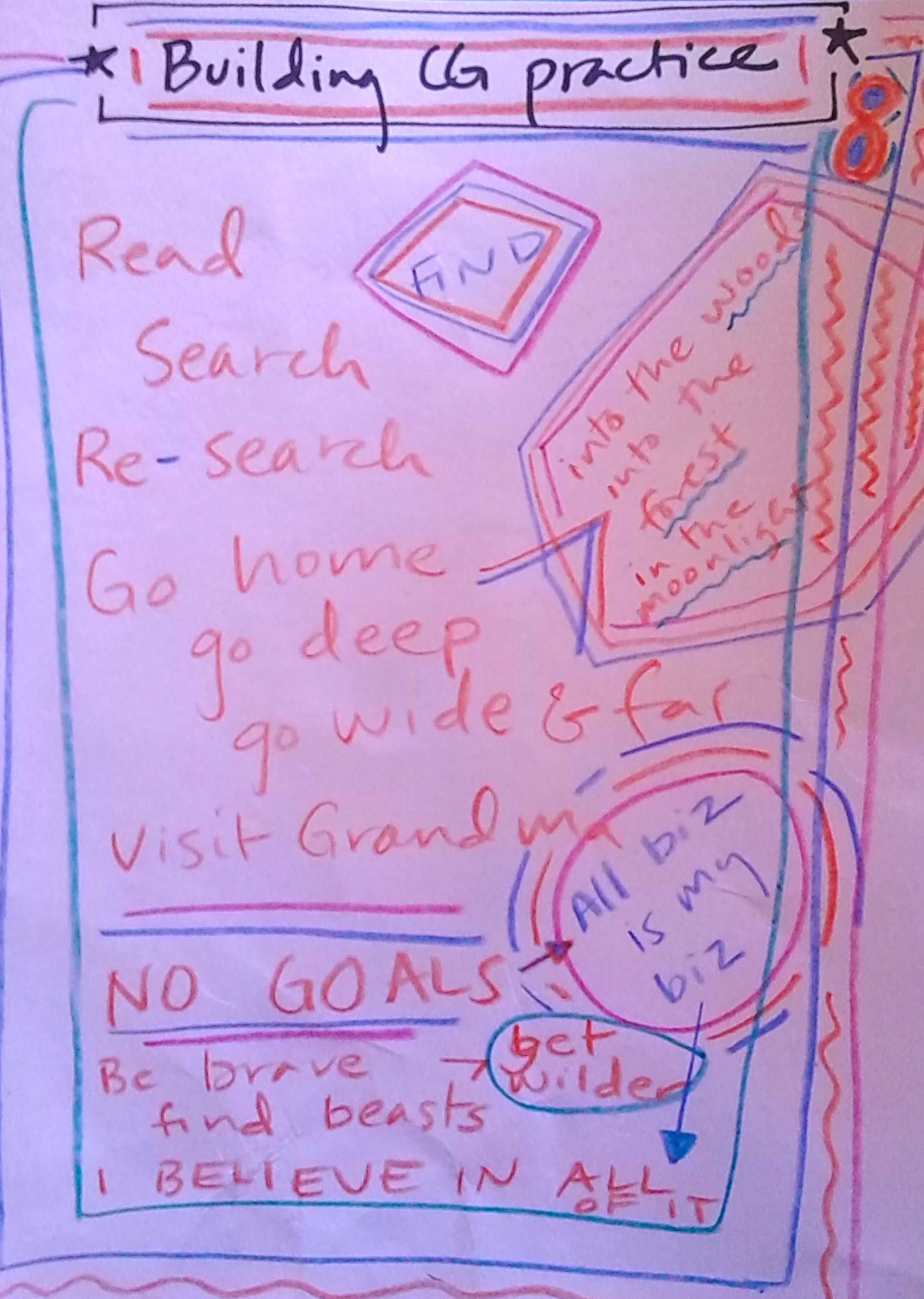
 Developing my creative guide practice 

Read

Search → Re-search

Go home / go deep / go wide and far 

VISIT GRANDMA

Ask questions 

NO GOALS → all business is my business I BELIEVE IN ALL OF IT

Be brave
Find beasts
Get wilder


It looks better with crayons:

IMG_20150120_135755

Try it yourself, see what comes to you! Maybe your braindream isn’t as wacked out as mine is, or maybe it’s waaaaaay further out there… only your brain can tell.

Creative Workout: in progress

We’ve had two sessions of the Creative Workout Group and I have to say, so far it’s been hilarious and brilliant and awkward in the best sense. What a brave and beautiful group of people.

  • We’ve felt our own heartbeats, and felt someone else’s heartbeat.
  • We’ve danced like we’re 9 years old and like we’re 90.
  • We’ve made fart noises while making intense eye contact, which never fails to make me laugh until I cry.
  • We’ve come up with alias names and power words.
  • We’ve shared what fascinates us and what frustrates us.
  • We’ve drawn spirals with our eyes closed to see what words and images come to mind when we think of a project.
  • We’ve described a project to someone else using only our eyes.
  • We’ve shared what we thought someone else’s project was (based on what their eyes told us).
  • We’ve come up with catchphrases / mantras / slogans (I don’t like any of these words, can we do a word association exercise to come up with a better one? And don’t suggest ‘branding’) to describe our projects.

There are some pretty incredible projects, and next week people will get to share them using words (not just their eyes). I can’t wait!

Try this: WORD ASSOCIATION

This is an exercise I use all the time when I find myself stuck around a particular word or phrase. I think I first read about it here but I’ve come across it other places too — in any case, this is my spin on it.

Here’s how it works:

1) Write the word or phrase that is tripping you up in big letters on a blank sheet of paper. Then write = [as many associations that come to your mind as you can].

DON’T THINK, just write as fast as you can. If you want, you can try writing with your left hand — that’s one way to tap into your creative/unconscious/unverbal brain.

Here’s an example, using something I frequently get tripped up over:

MONEY  = cash

= power

= freedom

= pain

= stuck up

= glamor

= fake

= plastic surgery

= cancer

= seductive

= can’t refuse

= Robert Redford, the devil, big ego, blind

= dollars $$$$

= less fighting

= time

= cage

= grandma

= strings attached

= residue

WHEW. That’s a lot of associations. Now you try it! You can use MONEY if you want, but it could be anything. LOVE. BABY. JOB. WINTER. BREAKFAST. Any words that are currently a flash point for you — that shut you down or light you up or make you think in circles.

2) Now, pick 5 of the words above, and go further. Whatever associations come up when you think of those words, write them down — even if they don’t make sense. Like this:

stuck up = suburbs, people moving away and getting stuck up, beige carpet, too quiet, dream house –> end of something.

strings attached = manipulation, forcing, not trusting, hoarding, puppetmaster.

plastic surgery = hollywood, once you start you can’t stop, can’t hold onto realness, can’t abide realness, cutting out humility and vulnerability and humanity, fucked up superhero.

can’t refuse = at mercy of boss because you need the paycheck, they own you because they pay you. Being bossed around, beholden.

3) Now brainstorm the opposites of those words:

stuck up –> low key, down to earth, more connected, putting time and money into something you love (a house you build with your own hands as opposed to a big cookie cutter house in the suburbs). Sharing what you have. Staying true to your roots.

strings attached –> giving with no expectation. Using money to connect and help people. Cutting strings, letting go. Opened up, not walled in. Giving things away, clearing, making space for new things. Following curiosities, using money to have adventures.

plastic surgery –> Frances McDormand, she doesn’t need plastic surgery. An interesting face. Being ok with your own face, with getting old, with wrinkles. Not improving yourself. Refusal = defiance = badass, refusing to be more than you are.

can’t refuse –> freelancer, what a beautiful word. No boss. Nothing owed to anyone.

Robert Redford –> what is the opposite of Robert Redford?! Barbra Streisand in The Way We Were? Kris Kristofferson? Someone who’s not afraid to play the bad guy, not trying to save the world, just doing their thing. NOT branding yourself.

You might notice some themes emerging, and if it helps, you can put them together into phrases and sentences. In my case, I’m noticing that I seem to believe that money is associated with presenting yourself as something you’re not — a superhero, a moral leader, a dream house — and being controlled by nefarious forces. No wonder I’m having issues with money!

What if instead of this hollywood suburban nightmare, I could exist in a down to earth world where people helped each other out and followed their curiosity? A world where I don’t owe anyone anything and can do exactly what I want and present myself exactly as I am. Hmmmm.

4) In that vein, I’m going to brainstorm all the qualities I’d LIKE to be associated with [that world / thing]:

[new thing]     = cash, free and clear

= paid in full

= currency — trades, services, symbols, metaphors, proxies

= fair exchange, fair trade, fair price for services rendered

= paid gigs

= no boss

= FREELANCER! (this reminds me of HIGHLANDER and immortality and Sean Connery)

= not a guru, not the good guy, not a moral leader, just a person

= being exactly what I am, presenting myself exactly as I am

= helping people, connecting people

= action (actions speak louder than words)

= have more adventures

= crowdsourcing / crowdsurfing

= economics

= transaction –> Trans Action –> exchange of energy, services, goods

5) Like in step 2, we’re going to pull out key words and push them further. Not all of these will lead to something tangible, but usually by the time I get to this stage, tangible action starts to appear. It may or may not be related to my original word, but then again, it might in a way my rational everyday mind doesn’t understand.

freelancer = get gigs, get the word out. Email friends, make facebook page, make business cards, put my thing out there, no big deal, take it or leave it. Explain it exactly as it is.

have more adventures = go on a hike every day. Eavesdrop on people when waiting in line instead of checking my phone…? Listen. Try posting whatever the hell I want on my blog. Wear a radical outfit. Buzz cut my hair.

helping people, connecting people = find free workshops to take, offer free workshops? Share ideas on blog.

trans action = try more things, do things for others, ask for help, ask for support when I need it, share more, risk letting people in even if it scares me. Invite more people over to my house. Set up playdates. What is a playdate between adults (not in a kinky way)?

And at this point, if a word or phrase has appeared that you can use in the place of the original word, awesome! Use it! In my case, I’m going to use the word Trans-Action so I can remember that I’m not cheating people out of their precious dollars by pretending to be a moral leader — no, I am using the resources I have to help people out and asking for help when I need it and following my own curiosity and going on adventures and connecting with other people who are doing this too. We are supporting each other.

So instead of saying ARGHH I NEED TO BE MAKING MORE MONEY I can now say, DANG, TIME TO STEP UP THE TRANS-ACTION! 

And instead of charging MONEY for my services (eeek, what a fraud, I’m cheating people, I’m a poser and a fake!*), I’m engaging in Trans-Actions in which people offer me something in exchange for what I’m offering them. Fair trade. They know what I’m offering, I know what they’re offering.

What do you think? Let me know what you find out if you try this exercise!

*related topic: imposter syndrome. Duh duh DUHHHHH! We’ll talk about that another time.