What would my alter ego do?

One of the things I love about acting is being able to step into and out of an alter ego.

I learned a long time ago that one way for me to be confident was to “play” someone confident onstage.

It took me a lot longer to figure out that I could use the same principle in my life offstage: that if I went into a situation with the right outfit / mantra / alter ego / attitude, I could fake my way into confidence.

I only learned this once life (in my case, having a baby) forced me to build a life outside the theater – and learning it is what propelled me to channel my theatre training into coaching. 

I tested this idea in my own life over the last month, as I performed my manifesto in the persona of a character who is basically me in a spectacular jumpsuit.

The outfit took on a life of its own, and to live up to the image it projected, I became another version of myself: someone who is sharper, bolder, more confident in her weirdness.

You can try this too, and you don’t have to go onstage to do it.

You can create an alter ego that is another version of yourself: stronger, clearer, more spaced out, softer, meaner, louder, grungier. It’s not about being better. It’s about what you learn about yourself when you step into another character. (Those of you who have children, or who remember your own childhoods, have probably seen this with your own eyes: when we’re little, we figure out who we are by pretending to be something else).

You can use this alter ego to test out what you want, what you think, what you fear, what you hate, what you think you’re capable of. You might be surprised by what you find out. (For example, I was very surprised to find out in the course of making my show that I love new age woo woo stuff once you take out the element of control, domination, betterment and perfection).

To create your own alter ego, here’s a good way to start:

  1. NAME
  2. OUTFIT
  3. MANTRA

I’ll walk you through it:

1. PICK A NAME

  • Look around until a random object catches your eye (here are some examples from where I’m sitting right now: stool, skeleton, iron, rainboots).
  • Pick a nickname you or someone you knew had in childhood (examples from people I know: Face, Boo, Kaa, Jaja).
  • Put the two names together (examples: Stool Face, Skeleton Boo, Kaa Iron, Jaja Rainboots). Voila! You’ve got an alter ego.

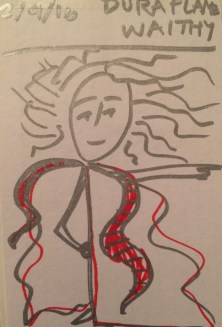
2. DRAW A TWO MINUTE SELF PORTRAIT OF YOUR ALTER EGO  

  • Set the timer for two minutes
  • Write the name on a piece of paper
  • Draw a picture of that character
  • Color it in with crayons or markers or a weird red pen

3. FREEWRITE FOR TWO MINUTES

  • Set the timer for two minutes again
  • Write what you see in the picture you drew
  • You could also answer these questions: Who is this person? What are their superpowers? What is their kryptonite? Where do they come from? What are they wearing? Who are they protecting? Who are they fighting? What car do they drive?
  • Look back over what you wrote, and circle 5-6 words that stand out to you.
  • Write those words in a list, then mess around with them until they become something like a mantra. It doesn’t have to make sense, but it needs to speak to you.

When I did this at our workshop last week, here’s what I came up with:

DURA-FLAME WAITHY
IMG_0621

Looking into the distance, wearing a cape of flame

So now what? What do you do with this alter ego?

I’ll tell you what: you practice stepping into those shoes. You channel it at boring parties or endless meetings or conversations at the grocery store. When you need to speak up, you think, what would my alter ego say? When you aren’t sure what to do, you ask, what would my alter ego do? And when you’re at a thrift store, you ask, what would my alter ego wear? And if you’re brave, you buy that piece of clothing and you wear it out in public and see what happens.

That’s enough to get you started! Let me know what you find out.

(And if you want to go deeper with this, come to the next Creative Living workshop or sign up for my 6-week coaxing program)
From DIY to Revolution in 10 Easy Steps

I had a session with someone the other day, and one of the things we talked about was how to build in accountability when you have a big idea, without making the pressure so big that you bail on it altogether out of fear.

This struck me as something we all struggle with, or at least, those of us who like to dream big. There’s a tendency to think that step one is doing only for yourself, and step two is sharing it with the world in a huge public way.

When in fact, there are a lot of steps in between.

In our session, we wrote out what those steps might look like, and came up with this:

  1. Do it for yourself
  2. Tell friends what you’re doing
  3. Invite people to play with you
  4. Invite a few strangers
  5. Publicize it
  6. ?
  7. ?
  8. ?
  9. ?
  10. Lead a revolution

I’m not sure what happens in steps 6-9, but I’d love to hear your ideas.

In the meantime, if there’s a project you are excited about but scared to share with the world, here is my assignment for you: what is the tiniest, easiest, most fun way you could share your thoughts?

Could you tell your kids about it?
Could you mention it to your friends over drinks?
Could you write a note and leave it somewhere for an anonymous person to find?
Could you write about it cryptically on facebook?
Could you google it and see if anyone else is as excited about it as you are?

Or here’s a thought: you could say something here or over on the facebook page! I’d love to know what you’re excited about.

My grand experiment

This weekend, I performed my manifesto-in-training to a fantastic crowd at the Risk/Reward Festival here in Portland.

Can I be honest, guys? (Or as Joan Rivers would say, can we talk?)

Going into this weekend, I wasn’t sure if I wanted to continue with this strange performance experiment that I’ve spent the last year working on. I thought this might be the end of the road, at least for a while.

It’s been a beautiful experiment. When I started, the aim was to see if it was possible to make a show that fit into my current lifestyle, and that actually improved my day to day life instead of requiring sacrifice. I used to make shows as if they were the sun and I was the moon. Everything I had went towards making them. And that’s okay! For a long time it was exciting. And then slowly it became unhealthy. And then when I gave birth to my son it became impossible. So with this show, I wanted the sun to be me — my body, my life, my family, my actual son — and the moon to be this show. It would exist to serve me, and not the other way around.

When I first had this thought, it seemed radical. I had a lot of questions:

  • Could I make a show whose #1 goal was to make my life better?
  • Could I use the show as an excuse to procure resources that I want in my life?
  • Could I rehearse a show by jotting things down in a notebook and inviting people to watch me try out those ideas once or twice a month? And could those ideas just be stuff I think about in the shower?
  • Could I make a show with zero collaborators?
  • Could I make a show with no set or costumes aside from what catches my eye at goodwill?

The short answer is: yes. I rehearsed at a very lackadaisacal pace (at least, compared to how I used to rehearse). I had a notebook next to the shower, and much of the material for the show came from what I mused about in there (or while nursing my son at 2am). Here’s what I spent money on:

$12 – jumpsuit

$14 – shitty easel (I wanted to return it and buy a better one, but it turns out easels are nonrefundable)

$10 – big paper

$24 – 2 fuzzy blankets on clearance, 2 pillows and one “carpet” which is really a bedspread from goodwill

$5 – an “altar” from goodwill

$15 – tape, markers and small objects for the altar

$27 – laminating 4 sheets of big paper

————————————–

$107 TOTAL

(Oh and of course, childcare — but I won’t include that number since I have a small seizure whenever I see it.)

I had no official collaborators and thus no meetings or emails or stress — but I did have help making the show from great artists I love and respect, whose insight I’m grateful for.

I wasn’t able to do all the things I originally built into the plan/budget — for instance, I still want to do intensive hypnosis training in Tacoma, and as I talk about in my show, originally I was going to pay a costume designer to make me a fabulous outfit. But I did in fact procure everything by wandering into thrift stores and seeing what caught my eye. And even though the Seattle Times thought that “with more polished production design it could easily become a ruby,” I am very happy to be a defiantly unpolished rhinestone.

So all in all, I’d have to say it’s an experiment that WORKED, and that is what I’m most amazed by. I always knew it would result in SOMETHING. But I didn’t know if that something would be good, or interesting to other people. And it turns out, it is! And the thing I’m second most amazed by is that I honestly don’t care (much) if people think it’s good or not. Somehow, after giving birth and embarking on all this self-exploration and Creative Guide-ness, the part of my brain that cares about what people think of me or my work onstage has switched off. (Or maybe not off, but to low burn.) I feel comfortable onstage. I feel comfortable talking about my work with people offstage, no matter what they think. If they don’t like it, that’s okay with me. Maybe this sounds like a small thing. But for me it is HUGE.

And I’m grateful and surprised as hell that the result of my experiment is a show I love warts and all, and that other people love too. And the upshot of it is, I want to continue this grand experiment, and make it into a 45-minute hybrid performance/seminar/ted talk. I want to keep doing it my way — no meetings, no emails, no crazy expectations, and if I can, money for pedicures built into the budget. And I want to take it all the way to Vegas. Well, maybe not to Vegas (though Celine, if you need an opening act, I’m available). But maybe to SXSW Interactive, the Canadian Fringe, the World Domination Summit…

Are those big goals? Does it seem a little nuts? Well, a year ago this whole idea sounded beautifully nuts, and I pulled it off.

So let’s drink a toast to following our beautifully nutso dreams and dance badly for 2.5 minutes to Celine Dion singing I Drove All Night.


ALSO: if you’d like to get some practice failing, flailing, falling, sprawling and doing things badly, come to my Sunday Morning Fail Zone workshop! Next one is this Sunday (July 19) at 10am. When we fail, we learn, evolve, grow and become stronger. We might as well enjoy the process.

I Don’t Trust a 100% Guarantee

… part of my walking-talking manifesto in progress, on the theme of I Hate Positive Thinking…


One meaning of ‘positive’ is 100% certain.

 I AM POSITIVE THAT THE THING I OFFER WILL HELP YOU.

 I guarantee if you use this system you’ll have massive breakthroughs in the next month.

 You’ll be making six figures in no time if you take these three steps. I promise.

 If you’re experiencing [random thing], I can guarantee that the problem is [something I can solve].

I’ve come to realize that I never trust anyone who 100% guarantees a result.

the power of positive thinking

To me, it’s an automatic bullshit detector. But it’s hard to avoid, because it’s tied in to the language of buying and selling. And because coaches and practitioners and healers are offering something intangible – a service, not a product – there is a temptation to make it feel more tangible by guaranteeing results.

5d7

This is one of the reasons I avoided entering this field for so long: I can’t stand seeing the realm of the unconscious reduced to being bought and sold like a product.

But can you be successful without doing that? This recovering life coach thinks you can’t, but I’m hoping you can. I’m heartened to see examples of coaches, counselors and mavens who offer great services without false guarantees or manipulation disguised as positive thinking.

And I think, if their honesty and humanity and humility is something that attracts me, then it can attract people to me too.

Because I think most of us would rather hang out with someone who’s being honest and real than giving us a line we want to hear.

So I’m not going to tell you that my approach is 100% GUARANTEED.

I’m not even going to tell you I have a foolproof, rock solid “approach,” as if it were a product I hammered out that sits on the shelf, gleaming and perfect. Nope.

What I have is a way in, based on years of working creatively with my own mind and body, and with other people. It is born out of the particulars of my circumstances – particulars that I think a lot of people share. It works for me, and it works for other people. But it is constantly evolving and doesn’t exist in a vacuum.

I could give you a pencil and the chances that you’d write something with it are high, but I have no idea. Maybe you’ll chew it. Maybe you’ll draw on the table. Maybe you’ll throw it across the room. Maybe you’ll break it into tiny pieces and fashion a miniature beaver dam.

high_242

The possibilities are endless, and that’s what I love about this work.

I give you tools, show you how to use them, and guide you through the process. Then you do the work, and see what arises. If you have a breakthrough, it comes from you and your life, your passion, your abilities – not some magic pill I conjured up for you.

That’s what I offer. A process that grows and changes depending on who is using it, when they use it, and how they use it. A process that I think is kick-ass, and which usually leads to insights, aha moments and shifts in perspective. It’s like a chemistry experiment: powerful things are bound to happen, but it’s impossible to predict exactly what.

That’s why we experiment: to find out what will happen. No guarantees, no promises, no bullshit.


Want to work on your own manifesto? Come to my free workshop on June 14! 

Manifesto in progress: I hate positive thinking

I don’t know if I’ve mentioned this, but I’ve been working on a solo performance this year that has one foot in the performance world and one foot in this new world I’ve ventured into, the world of (duh duh DUHHHHH) self-help.

It’s strange that I’m in this new world, since most of my life I’ve had an aversion to the idea of self-help and positive thinking. In fact, that’s the title of my show: I HATE POSITIVE THINKING.

It’s about this tension I feel, as someone working in the life coaching field who can’t stand the terms abundance, manifesting, law of attraction and poverty mindset. In essence, it’s my manifesto, on its feet, in progress. A living manifesto.

I’ll be sharing bits and pieces from my living manifesto in the coming weeks as I get ready to take it to the NW New Works Festival, so you can see for yourself what I do and do not stand for. One things I most certainly DO stand for is Stevie Wonder. He is a goddamn treasure (check out how he breaks it down starting at 7:29):

But I also want to encourage you to write / create / dance / draw your own manifesto.

In fact, that is the theme of the next Sunday Morning Creative Zone workshop: THE ART OF THE MANIFESTO (manifesti?)

And it just occured to me — as someone who hates the term ‘manifesting’, it’s funny that I love the term manifesto. Maybe that’s my philosophy in one sentence: I don’t want you to manifest wealth, health and abundance. I want you to get on your feet and MANIFESTO it.

Carry on, brave friends.

practice failing

Everyone knows that the way to innovate, grow and become smarter is to fail.

Fail more, fail better, fail smarter, fail wisely – experts agree that if you want to succeed, you need to be willing to fail.

Which is great. I get that, intellectually.

But how do you actually DO it?

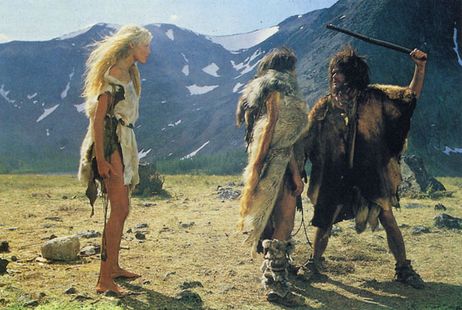
Because no matter how strongly you believe in it’s importance, or how many strong words you put next to it, the fact remains that actually failing is scary as hell. We are socially wired to avoid failure at all costs for fear of being banished from the tribe and left out in the wilderness to die (though if you find yourself in that scenario, reading Clan of the Cave Bear and asking yourself, what would Ayla do? will go a long ways towards assuring your survival).

From author Jean Auel’s website:

In Ayla’s story readers find what very well may be the story of human survival, for it is by wit, instinct, adaptation, and gathering knowledge that Ayla thrives among a people who are not like her, in a society that sees her as strange, in a world where elements, animals, and the enmity of others make surviving each day a challenge.

Anyway, point is, many of us avoid failure in high stakes situations, because when the stakes are high, you are in survival mode, and survival mode tells you it is imperative that you not fail, that you fit in, that you win. But as Ayla would tell you, this is exactly the situation when having a good relationship with your fear of failure can help you. Because here is the thing:

Failure is a potential – even likely – outcome, no matter WHAT you do.

You can’t control when and where it will rear it’s head.

What you can control is your response to it.

So for instance, if you find yourself alone with a bear and your slingshot misfires, you are in much better shape if you have experienced a misfire many, many times before. If you have only operated your slingshot (I have no idea what a slingshot is exactly or if it can misfire, but let’s stay with this metaphor anyway) under optimal conditions, then you will have no idea what to do when it doesn’t work.

It is avoidance of failure that can get you killed, and it is being on good terms with failure that can help you survive.

So, back to our original question: HOW to get on good terms with failure?

I think the way to do this is to practice failing when the stakes are low. To embrace it when you aren’t, say, starting a new job or putting your savings account on the line or moving to a brand new city.

This Sunday, I am offering space to do just that, in my “I’m the Worst” workshop.

We are going to not merely be OKAY with failure, to TOLERATE our mistakes. We are going to try our hardest to make them, in the biggest, boldest, dumbest way possible.

 We are going to celebrate failure.

We are going to fail over and over again.

We are going to see what it means to win at losing.

We aren’t going to do this because we enjoy looking like jackasses (though we might enjoy it a little bit). We are going to do this so we can encounter that fear, dance with it, and get to know it. We are going to do this so we are well acquainted with falling.

Have you ever watched a baby learn how to walk? There is a LOT of falling involved. Like way more than seems reasonable. A lot of tipping over and lurching and bumping into things and tripping and getting stuck. And then, slowly, they learn how to balance their weight, how to right themselves, how to measure their footsteps, when to jump and when to shuffle, how to recover their balance gracefully – how not to fall.

That is what we are going to do! Spend two hours falling and failing. (And if you can’t be there in person, you can play along at home by failing at something low-stakes this week and seeing how it feels. You could tell a bad joke at a party. You could wear an ugly outfit around the house. You could wear it out dancing. You could dance like Elaine. The options are limitless.)

Then maybe next time we find ourselves in a high stakes situation, we can go into it thinking, hey, I’ve failed before, it’s not so bad.

I’m going to spend two minutes being awkward at this party and then I’m going to find someone I like talking to and we will hit it off.

I’m going to sweat too much, talk too fast and make a dumb joke in this job interview, and then I’m going to ask some good questions and show them I know what I’m talking about.

I’m going to spend 6 weeks (or months) having nightly panic attacks in my empty apartment and going to random coffee shops and the wrong bars before I find the right ones and figure out where my people are.

See what I mean? If you’re ready for it, it’s a little less scary. If you’ve experienced flop sweat and survived, you know it’s not as life threatening as you think it is.

So let’s do this!

Scene-from-the-film-version-of-Clan-of-the-Cave-Bear

Being Confident, part I: what does it mean

Confidence is a word that fascinates me.

It seems to fascinate everyone. It’s almost impossible to read anything self-help oriented without someone telling you to BE CONFIDENT! (The other thing you should always do is BE YOURSELF – if your real self is not confident, I guess you’re shit out of luck).

So I thought maybe we could break down the word confidence and see what’s behind it, since we’re all so in love with it.


CONFIDENCE = with strength

 = sureness

 = sure grasp of situation, facts

 = comfortable in your skin

 = leader

 = charismatic

 = fortress – unbreakable – impenetrable

 = armor = projecting an image of strength = invulnerable

 = secrecy — sharing a secret in confidence — a confidante

 = trust — you have the trust of others

 = con man (literally a confidence man) – a professional liar, a swindler


A few interesting things here:

Confidence is an action, an exchange – the act of confiding or being confided in – a transaction between people, not a static state.

Confidence is conferred upon you by others. You inspire confidence, which means you inspire others to trust you.

When people give you their trust, they are opening themselves up to potential danger. They have confidence in you, but they also know that you could take advantage of them.

Here’s another way of thinking about it: we trust someone who is holding down the fort, because we have to. We don’t want someone guarding the gates who will fumble with the arrows. But we also know that no one has 100% sure aim. And so when we put our trust in someone, we are also acknowledging our dependence on them, which is an inherently risky state.

Confidence is also something that we project outward about ourselves in order to protect our vulnerable real selves.

And yet by projecting a fortress of strength, we are by nature projecting a false reality, which we know is false. We know that we are not in fact infallible and inviolable.  So we are depending on this fortress of certitude to protect us, and simultaneously doubting it’s strength.

This is very interesting!

It suggests that confidence and doubt are much more intertwined than we think.

Which makes sense to me. I always find it strange when someone tells me to be more confident, because I feel confident, even when I’m in the grips of the strongest self-doubt. Seeing it through this lens, I realize that when someone tells me to be more confident, what they’re saying is, I don’t trust you.

Hmmm. Is this true, or did I just fall down a word association rabbit hole? I’ve got more to say about this, but it will have to wait for next time.

Justin thinks she’s confident (I think this song is terrible)