What would my alter ego do?

One of the things I love about acting is being able to step into and out of an alter ego.

I learned a long time ago that one way for me to be confident was to “play” someone confident onstage.

It took me a lot longer to figure out that I could use the same principle in my life offstage: that if I went into a situation with the right outfit / mantra / alter ego / attitude, I could fake my way into confidence.

I only learned this once life (in my case, having a baby) forced me to build a life outside the theater – and learning it is what propelled me to channel my theatre training into coaching. 

I tested this idea in my own life over the last month, as I performed my manifesto in the persona of a character who is basically me in a spectacular jumpsuit.

The outfit took on a life of its own, and to live up to the image it projected, I became another version of myself: someone who is sharper, bolder, more confident in her weirdness.

You can try this too, and you don’t have to go onstage to do it.

You can create an alter ego that is another version of yourself: stronger, clearer, more spaced out, softer, meaner, louder, grungier. It’s not about being better. It’s about what you learn about yourself when you step into another character. (Those of you who have children, or who remember your own childhoods, have probably seen this with your own eyes: when we’re little, we figure out who we are by pretending to be something else).

You can use this alter ego to test out what you want, what you think, what you fear, what you hate, what you think you’re capable of. You might be surprised by what you find out. (For example, I was very surprised to find out in the course of making my show that I love new age woo woo stuff once you take out the element of control, domination, betterment and perfection).

To create your own alter ego, here’s a good way to start:

  1. NAME
  2. OUTFIT
  3. MANTRA

I’ll walk you through it:

1. PICK A NAME

  • Look around until a random object catches your eye (here are some examples from where I’m sitting right now: stool, skeleton, iron, rainboots).
  • Pick a nickname you or someone you knew had in childhood (examples from people I know: Face, Boo, Kaa, Jaja).
  • Put the two names together (examples: Stool Face, Skeleton Boo, Kaa Iron, Jaja Rainboots). Voila! You’ve got an alter ego.

2. DRAW A TWO MINUTE SELF PORTRAIT OF YOUR ALTER EGO  

  • Set the timer for two minutes
  • Write the name on a piece of paper
  • Draw a picture of that character
  • Color it in with crayons or markers or a weird red pen

3. FREEWRITE FOR TWO MINUTES

  • Set the timer for two minutes again
  • Write what you see in the picture you drew
  • You could also answer these questions: Who is this person? What are their superpowers? What is their kryptonite? Where do they come from? What are they wearing? Who are they protecting? Who are they fighting? What car do they drive?
  • Look back over what you wrote, and circle 5-6 words that stand out to you.
  • Write those words in a list, then mess around with them until they become something like a mantra. It doesn’t have to make sense, but it needs to speak to you.

When I did this at our workshop last week, here’s what I came up with:

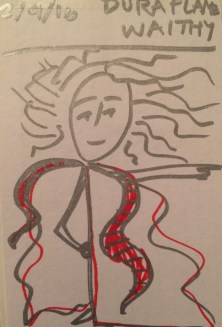
DURA-FLAME WAITHY
IMG_0621

Looking into the distance, wearing a cape of flame

So now what? What do you do with this alter ego?

I’ll tell you what: you practice stepping into those shoes. You channel it at boring parties or endless meetings or conversations at the grocery store. When you need to speak up, you think, what would my alter ego say? When you aren’t sure what to do, you ask, what would my alter ego do? And when you’re at a thrift store, you ask, what would my alter ego wear? And if you’re brave, you buy that piece of clothing and you wear it out in public and see what happens.

That’s enough to get you started! Let me know what you find out.

(And if you want to go deeper with this, come to the next Creative Living workshop or sign up for my 6-week coaxing program)

The Ingratitude Challenge

There are plenty of things I’m grateful for, and when the feeling of gratefulness washes over me, it’s a beautiful feeling.

For some reason, though, whenever I see one of the many varieties of “100 Days of Gratitude,” I feel the opposite of grateful.

Not at the person posting. And not even about whatever it is they’re grateful for. I don’t know, something about the forced cheerfulness of it makes me feel like this:

wilford-brimley-06

And because I’ve been making a solo performance / manifesto over the last year or so about why positive thinking doesn’t work (among other things), I had the idea the other day of starting an Ingratitude Challenge.

It made me laugh to imagine it, and then I thought: hey, this would be a good experiment. What happens if I post every day about something I am not grateful for — something that SUCKS?

Here’s what I want to find out:

  1. Does focusing on what you are not grateful for make you feel less grateful?
  2. Or will it actually have the opposite effect?

My instinct is that #2 will be true, and so far that has proven to be true. Today when I sat down to think about what I was going to say, the act of trying to be ungrateful made my mind suddenly flood with things I was grateful for.

Strange, isn’t it?

Anyway, so I’m curious to see what happens. For ten days leading up to the opening of my show, I am going to talk about something I am supremely ungrateful for every day.

There is only one rule: keep the focus on what sucks. No silver linings, no sympathy, no bright sides.

Want to join in? Share this on facebook or look for the #IngratitudeChallenge on twitter.

TRY THIS: HAIKU YOUR LIFE

Here’s an exercise I’ve been using a lot lately.

It evolved out of my daily creative check-in — a 2-minute self portrait, then a 2-minutes free-write. I felt like I needed something to cap it off, so I  started circling 5-7 words and making them into a kind of poem or mantra. A haiku for the day, if you will (though it’s technically not a haiku).

Lately I’ve been trying a different kind of haiku hybrid: the 7 words or less challenge.

The idea is simple. You pick your topic — maybe an event in your past, or what you want to do today, or looking back on the week — and then express it in seven words.

For someone like me, who processes visually & verbally – often with a rush of words that overwhelm like a waterfall – there is something satisfying about the limitation of saying it in seven words.  They have to pack a punch, like Hemingway.

And what surprises me is that it often isn’t hard to do. In fact, I’d go as far as to say I could get the essence of any event in my life across to you in 7 words. Maybe better than if we sat down for a long talk over coffee.

Does that sound like a challenge? Join me, let’s give it a shot!

Here, I will talk you through it.

Approach #1: Freewrite and select words

Set the timer for two minutes, and write freely about whatever is on your mind. If you want, pick a starting point or question, like “the week in review,” or “how am I feeling today,” or “what I need to do.”

Now write anything you want for two minutes. Don’t think about it, and don’t try and answer the question. Write whatever words float into your brain, even if it’s just one word over and over. It doesn’t have to make sense. Just move your pen across the paper.

When you’re done, let your eyes wander back over what you wrote, and circle the first seven words that jump out at you. (You can do more or less words, but I find 7 is a good rule of thumb).

Now write those words down, and play around with them.

Here’s an example of how this went for me a couple weeks ago. I wrote about how I was feeling in the morning, and then circled 7 words that stood out:

wild, riot, flower pot, rich, soil, growth

I turned those words into this little poem:

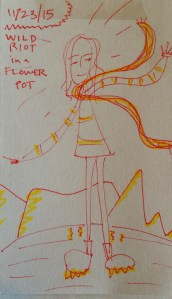
wild riot in a flower pot

IMG_0063

Approach #2: Haiku Hybrid in 7 words or less

Decide on a topic. Here are some ideas:

– a life event I obsess about
– why I’m like my mom
– my first boyfriend
– a fight with my best friend
– my neighbor growing up
– a time I failed
– my year in review
– what I want in 2016
– what I learned from my family
– my superpowers
– my parenting style
– the opposite of what I want to do
– a book that made me cry
– the first movie that scared me
– favorite piece of clothing
– music I will not listen to
– ideal vacation / job / life / day…
– my birth story
– what needs to change
– something traumatic
– something transcendent
– something that changed me
– who I was five years ago
– what I wish I knew when I was 20
– who I will be in ten years

Or you can keep it open and talk about your week or what you’re feeling.

Now say it in 7 words or less. You can use the idea of “words” loosely – I interpret it more as key phrases or  snapshots of the experience you’re describing (as opposed to 7 words in a logical sentence).

So for instance, here is how I would describe my week in seven words or less:

Insomnia
Night weaning
6:30 am
Running hug
Calendar Tetris

That might not make sense to you, but it does to me! Here’s another example:

Theme: Dark time in my life 5 years ago:*

year of yes
goddess group
psychic
pregnant
prediction
miscarriage
year of no

Here’s another one off the top of my head:

Why I don’t watch horror movies:

Blood
Shock
Visual cortex
Stupid
Can’t sleep
Pass out

Isn’t it interesting how this tells you a different kind of story than if I explained in detail why I don’t watch horror movies? It lets your mind fill in the gaps – it’s more of a game between us, which is more interesting for both of us than me telling you what happened.

BONUS: if you do this in your journal, you can look back over your hybrid haikus and see if any themes emerge.

And if you want, post your haiku in the comments or on the facebook page!

*if any of you have seen my solo show / manifesto, you saw me try a version of this in front of an audience! Which you will be able to see again in January when I do the full show here in Portland. Tickets are on sale now!

From DIY to Revolution in 10 Easy Steps

I had a session with someone the other day, and one of the things we talked about was how to build in accountability when you have a big idea, without making the pressure so big that you bail on it altogether out of fear.

This struck me as something we all struggle with, or at least, those of us who like to dream big. There’s a tendency to think that step one is doing only for yourself, and step two is sharing it with the world in a huge public way.

When in fact, there are a lot of steps in between.

In our session, we wrote out what those steps might look like, and came up with this:

  1. Do it for yourself
  2. Tell friends what you’re doing
  3. Invite people to play with you
  4. Invite a few strangers
  5. Publicize it
  6. ?
  7. ?
  8. ?
  9. ?
  10. Lead a revolution

I’m not sure what happens in steps 6-9, but I’d love to hear your ideas.

In the meantime, if there’s a project you are excited about but scared to share with the world, here is my assignment for you: what is the tiniest, easiest, most fun way you could share your thoughts?

Could you tell your kids about it?
Could you mention it to your friends over drinks?
Could you write a note and leave it somewhere for an anonymous person to find?
Could you write about it cryptically on facebook?
Could you google it and see if anyone else is as excited about it as you are?

Or here’s a thought: you could say something here or over on the facebook page! I’d love to know what you’re excited about.

STUPID SOLUTIONS TO A BIG PROBLEM: GUN VIOLENCE

One exercise I do in my failure workshops that’s always a surprise hit is ‘Stupid Solutions to Big Problems’. We form teams and brainstorm stupid solutions to huge, urgent, seemingly intractable problems. It’s strangely cathartic, and often the weirdest, wildest ideas are actually kind of great.

I bring this up because today, once again, I am confronted by a horrifying, endlessly repeating problem: gun violence.

And I cannot bear to see the same old helpless questions and dialogues and discussions and nothing happen in response.

So I thought: why don’t I brainstorm some stupid solutions? At least it will distract me from the sheer awfulness for a while. And so I present to you:

STUPID SOLUTIONS TO A BIG PROBLEM: the gun violence edition

  1. Mandatory support groups for all gun owners to talk about their feelings. Like you can’t buy a gun unless you attend two meetings involving group hugs, crying it out and learning how to speak your anger.
  1. Someone hire clowns to trail the NRA and freak them out until they do something about this. Clowns with guns? Is that too much? Can’t be worse than what we already have.
  1. Stop talking to any friends with guns until they shut down the fucking NRA.
  1. This might be a good idea actually – can we boycott the NRA? Obviously the NRA doesn’t give a shit if I boycott them, but could responsible gun owners boycott the NRA? Would you do that, guys? Would you boycott hunting – refuse to buy any hunting gear, licenses, guns and whatever else you buy when you hunt until the NRA backs down and legislation is passed?
  1. Fine anyone who sells a gun to a mass shooter a million dollars. Like the OLCC does for bartenders who serve alcohol to someone who goes on to get in a drunk driving accident.

Here’s what the OLCC says:

Q: What will happen to me if I allow a visibly intoxicated person to continue to drink alcohol?

A: You could be fined and your license or service permit suspended. Repeated violations could lead to the cancellation of your license or service permit. In addition, you could be held liable in a third party liability law suit if the visibly intoxicated person injures another person or damages someone else’s property.

OK, call me stupid, but couldn’t we do the exact same thing if someone sells a gun to a shooter? Just swap out ‘visibly intoxicated’ with ‘visibly planning to shoot someone’.

  1. Give mass shooters an infantilizing nickname and never use their actual picture, instead use a cartoon image that makes them look ridiculous, like this:

Lots of Kids Dead in Mass Shooting by Loony Lardface

IMG_20151001_210112

Fantastic. Well, I feel a little less consumed by rage and horror. If you have some stupid ideas to share, I would love to hear them!

Shitty first drafts, or learning to love failure

Anne Lamott talks about the importance of the shitty first draft when starting a new writing project.

For me and most of the other writers I know, writing is not rapturous. In fact, the only way I can get anything written at all is to write really, really shitty first drafts.

The first draft is the child’s draft, where you let it all pour out and then let it romp all over the place, knowing that no one is going to see it and that you can shape it later. You just let this childlike part of you channel whatever voices and visions come through and onto the page.

I want the Fail Zone to be a space where we can practice the shitty first draft of whatever we’re working on.

What is the equivalent of a shitty first draft for a dance piece, or an elevator pitch, or cleaning out your closet?

We’ll find out this Sunday! Bring a project, an idea or a goal, and we will find a way to practice it with romping, child-like glee.

Here are some ideas to of how it might play out:

GOAL: get a fantastic new job. SHITTY FIRST DRAFT: We take turns asking you questions and you answer them as badly as possible. Or you could draft a shitty resume with crayons.

GOAL: rock a karaoke power ballad. SHITTY FIRST DRAFT: sing it in front of us as badly as you can. If you want, we can back you up with shitty backup dancing/singing.

GOAL: get your 2 year old to sleep through the night. SHITTY FIRST DRAFT: brainstorm stupid solutions with the group and put together a ridiculous, wildly inconsistent sleep plan.

GOAL: make a full length dance piece. SHITTY FIRST DRAFT: choreograph a shitty 5-minute version of the piece you imagine. Show it to the group.

GOAL: submit a grant application. SHITTY FIRST DRAFT: write a self indulgent way too long project description. Read it out loud to us.

GOAL: keep your house clean. SHITTY FIRST DRAFT: what is the laziest, dumbest, least efficient way to clean up a mess? Brainstorm with the group. Or practice cleaning up a corner of the room like a 3-year-old.

GOAL: perform a standup comedy routine. SHITTY FIRST DRAFT: try out some awkward, tasteless, not funny jokes on us.

GOAL: do a keynote presentation at a conference. SHITTY FIRST DRAFT: put together inane powerpoint slides and practice bombing in front of us.

There are so many ways this could go. Bring anything. Or come with an empty mind and receive a wild card failure assignment from me.  

And if this is making you anxious, let me assure you: the point is to make it FUN and EASY to fail. No one will be forced to do anything. This is an opt-in, laugh at yourself, take the pressure off situation. If it feels hard, that means we need to rethink it until it’s ridiculously, stupidly easy for you to do.

Ready for failure practice? YEAH! Dig out your ripped up sweatpants and an old t-shirt and let’s do this.

My grand experiment

This weekend, I performed my manifesto-in-training to a fantastic crowd at the Risk/Reward Festival here in Portland.

Can I be honest, guys? (Or as Joan Rivers would say, can we talk?)

Going into this weekend, I wasn’t sure if I wanted to continue with this strange performance experiment that I’ve spent the last year working on. I thought this might be the end of the road, at least for a while.

It’s been a beautiful experiment. When I started, the aim was to see if it was possible to make a show that fit into my current lifestyle, and that actually improved my day to day life instead of requiring sacrifice. I used to make shows as if they were the sun and I was the moon. Everything I had went towards making them. And that’s okay! For a long time it was exciting. And then slowly it became unhealthy. And then when I gave birth to my son it became impossible. So with this show, I wanted the sun to be me — my body, my life, my family, my actual son — and the moon to be this show. It would exist to serve me, and not the other way around.

When I first had this thought, it seemed radical. I had a lot of questions:

  • Could I make a show whose #1 goal was to make my life better?
  • Could I use the show as an excuse to procure resources that I want in my life?
  • Could I rehearse a show by jotting things down in a notebook and inviting people to watch me try out those ideas once or twice a month? And could those ideas just be stuff I think about in the shower?
  • Could I make a show with zero collaborators?
  • Could I make a show with no set or costumes aside from what catches my eye at goodwill?

The short answer is: yes. I rehearsed at a very lackadaisacal pace (at least, compared to how I used to rehearse). I had a notebook next to the shower, and much of the material for the show came from what I mused about in there (or while nursing my son at 2am). Here’s what I spent money on:

$12 – jumpsuit

$14 – shitty easel (I wanted to return it and buy a better one, but it turns out easels are nonrefundable)

$10 – big paper

$24 – 2 fuzzy blankets on clearance, 2 pillows and one “carpet” which is really a bedspread from goodwill

$5 – an “altar” from goodwill

$15 – tape, markers and small objects for the altar

$27 – laminating 4 sheets of big paper

————————————–

$107 TOTAL

(Oh and of course, childcare — but I won’t include that number since I have a small seizure whenever I see it.)

I had no official collaborators and thus no meetings or emails or stress — but I did have help making the show from great artists I love and respect, whose insight I’m grateful for.

I wasn’t able to do all the things I originally built into the plan/budget — for instance, I still want to do intensive hypnosis training in Tacoma, and as I talk about in my show, originally I was going to pay a costume designer to make me a fabulous outfit. But I did in fact procure everything by wandering into thrift stores and seeing what caught my eye. And even though the Seattle Times thought that “with more polished production design it could easily become a ruby,” I am very happy to be a defiantly unpolished rhinestone.

So all in all, I’d have to say it’s an experiment that WORKED, and that is what I’m most amazed by. I always knew it would result in SOMETHING. But I didn’t know if that something would be good, or interesting to other people. And it turns out, it is! And the thing I’m second most amazed by is that I honestly don’t care (much) if people think it’s good or not. Somehow, after giving birth and embarking on all this self-exploration and Creative Guide-ness, the part of my brain that cares about what people think of me or my work onstage has switched off. (Or maybe not off, but to low burn.) I feel comfortable onstage. I feel comfortable talking about my work with people offstage, no matter what they think. If they don’t like it, that’s okay with me. Maybe this sounds like a small thing. But for me it is HUGE.

And I’m grateful and surprised as hell that the result of my experiment is a show I love warts and all, and that other people love too. And the upshot of it is, I want to continue this grand experiment, and make it into a 45-minute hybrid performance/seminar/ted talk. I want to keep doing it my way — no meetings, no emails, no crazy expectations, and if I can, money for pedicures built into the budget. And I want to take it all the way to Vegas. Well, maybe not to Vegas (though Celine, if you need an opening act, I’m available). But maybe to SXSW Interactive, the Canadian Fringe, the World Domination Summit…

Are those big goals? Does it seem a little nuts? Well, a year ago this whole idea sounded beautifully nuts, and I pulled it off.

So let’s drink a toast to following our beautifully nutso dreams and dance badly for 2.5 minutes to Celine Dion singing I Drove All Night.


ALSO: if you’d like to get some practice failing, flailing, falling, sprawling and doing things badly, come to my Sunday Morning Fail Zone workshop! Next one is this Sunday (July 19) at 10am. When we fail, we learn, evolve, grow and become stronger. We might as well enjoy the process.

What do I do? (A primer with fart sounds)

When I tell people I’m a Creative Guide, the next question I usually get is, what is that?

Or, so what do you do exactly?

They’re good questions. What DO I do, exactly?

I tell people that I “use creative tools” and “help people get in touch with their imagination” but this doesn’t sound very tangible. And in fact, the work we do often IS tangible. As in, perceptible by touch, palpable, real, and substantial.

I thought the best way to get this across would be to take a page from my own toolbox (my toolbox is FILLED with pages) and take these three steps:

  • name things
  • write the names on cards
  • arrange the cards on big paper

So that’s what I did! Here it is:

IMG_20150616_114857

My approach comes down to 6 principles:

  1. Ask questions
  2. Experiment
  3. Paradox: mess with binary oppositions
  4. Radical empathy + honesty
  5. Slow down, look & listen
  6. Do it badly

And I guess there’s a 7th wild card principle which doesn’t get a card because it pervades everything: go deeper by not taking things too seriously.

Or: take everything to heart while laughing your ass off.

An example of the wild card principle in action: one of my go-to exercises when I’m first working with people is to look deep into each other’s eyes while making fart sounds.

It sounds so stupid! And it is! We’re open and receptive, and we’re giggling like kids. An excellent place to start.

My point is, these principles might sound airy, but they are all about action that you can take, starting now, that shift your perspective and shift your world.

I’m going to talk about each of my guiding principles (god, hopefully I come up with a better word than principles… guiding lights?) in the weeks to come, and if you’re worried that it will be boring, I vow to include videos and dumb things to make you laugh.

In fact, I’ll start now! Let’s do the fart exercise together! I know we’re not actually in the same room right now, but let’s pretend we are and make fart sounds for 30 seconds. I bet you can’t do it without laughing, but if you do, you win a SERIOUS FART SOUNDER award (email me your address and I’ll mail it to you, for real.)

SFS Award

Ready? Let’s go. I’m going to say my name and title so I sound super important, and then I’ll pause to give you time to say yours, and then we’ll make fart sounds. YES!

I Don’t Trust a 100% Guarantee

… part of my walking-talking manifesto in progress, on the theme of I Hate Positive Thinking…


One meaning of ‘positive’ is 100% certain.

 I AM POSITIVE THAT THE THING I OFFER WILL HELP YOU.

 I guarantee if you use this system you’ll have massive breakthroughs in the next month.

 You’ll be making six figures in no time if you take these three steps. I promise.

 If you’re experiencing [random thing], I can guarantee that the problem is [something I can solve].

I’ve come to realize that I never trust anyone who 100% guarantees a result.

the power of positive thinking

To me, it’s an automatic bullshit detector. But it’s hard to avoid, because it’s tied in to the language of buying and selling. And because coaches and practitioners and healers are offering something intangible – a service, not a product – there is a temptation to make it feel more tangible by guaranteeing results.

5d7

This is one of the reasons I avoided entering this field for so long: I can’t stand seeing the realm of the unconscious reduced to being bought and sold like a product.

But can you be successful without doing that? This recovering life coach thinks you can’t, but I’m hoping you can. I’m heartened to see examples of coaches, counselors and mavens who offer great services without false guarantees or manipulation disguised as positive thinking.

And I think, if their honesty and humanity and humility is something that attracts me, then it can attract people to me too.

Because I think most of us would rather hang out with someone who’s being honest and real than giving us a line we want to hear.

So I’m not going to tell you that my approach is 100% GUARANTEED.

I’m not even going to tell you I have a foolproof, rock solid “approach,” as if it were a product I hammered out that sits on the shelf, gleaming and perfect. Nope.

What I have is a way in, based on years of working creatively with my own mind and body, and with other people. It is born out of the particulars of my circumstances – particulars that I think a lot of people share. It works for me, and it works for other people. But it is constantly evolving and doesn’t exist in a vacuum.

I could give you a pencil and the chances that you’d write something with it are high, but I have no idea. Maybe you’ll chew it. Maybe you’ll draw on the table. Maybe you’ll throw it across the room. Maybe you’ll break it into tiny pieces and fashion a miniature beaver dam.

high_242

The possibilities are endless, and that’s what I love about this work.

I give you tools, show you how to use them, and guide you through the process. Then you do the work, and see what arises. If you have a breakthrough, it comes from you and your life, your passion, your abilities – not some magic pill I conjured up for you.

That’s what I offer. A process that grows and changes depending on who is using it, when they use it, and how they use it. A process that I think is kick-ass, and which usually leads to insights, aha moments and shifts in perspective. It’s like a chemistry experiment: powerful things are bound to happen, but it’s impossible to predict exactly what.

That’s why we experiment: to find out what will happen. No guarantees, no promises, no bullshit.


Want to work on your own manifesto? Come to my free workshop on June 14! 

Manifesto in progress: I hate positive thinking

I don’t know if I’ve mentioned this, but I’ve been working on a solo performance this year that has one foot in the performance world and one foot in this new world I’ve ventured into, the world of (duh duh DUHHHHH) self-help.

It’s strange that I’m in this new world, since most of my life I’ve had an aversion to the idea of self-help and positive thinking. In fact, that’s the title of my show: I HATE POSITIVE THINKING.

It’s about this tension I feel, as someone working in the life coaching field who can’t stand the terms abundance, manifesting, law of attraction and poverty mindset. In essence, it’s my manifesto, on its feet, in progress. A living manifesto.

I’ll be sharing bits and pieces from my living manifesto in the coming weeks as I get ready to take it to the NW New Works Festival, so you can see for yourself what I do and do not stand for. One things I most certainly DO stand for is Stevie Wonder. He is a goddamn treasure (check out how he breaks it down starting at 7:29):

But I also want to encourage you to write / create / dance / draw your own manifesto.

In fact, that is the theme of the next Sunday Morning Creative Zone workshop: THE ART OF THE MANIFESTO (manifesti?)

And it just occured to me — as someone who hates the term ‘manifesting’, it’s funny that I love the term manifesto. Maybe that’s my philosophy in one sentence: I don’t want you to manifest wealth, health and abundance. I want you to get on your feet and MANIFESTO it.

Carry on, brave friends.