Try this: Invent your own superhero

This past Sunday, we had a lovely workshop on the theme of alternate worlds / alternate lives. There were only two of us (it’s hard to compete with a warm sunny day in Portland), but we inhabited our alter-egos (Lightbulb Helmet and Craesie Fleur) with aplomb.

If you’d like to do some world shaking on your own time, I invite you to try one of the exercises we did in the workshop: invent your own superhero.

Step 1: Get some paper and a pen, sit down and close your eyes. Let the image of a superhero float into your mind.

Step 2: Jot down answers to these questions (don’t think about them — write the first things that come to mind):

  • What is their superpower?
  • Where did they come from — what is their origin story?
  • What is their fatal flaw or weakness?
  • What kind of outfit do they wear?
  • What vehicle do they drive?
  • Who are their helpers?
  • Who are their enemies — who are they fighting?
  • What are they fighting for?
  • Who are they protecting?

Step 3: Draw a picture of your superhero based on what you wrote down.

Step 4: What is your superhero’s name? Do they have a catchphrase?

Splendid! Now if you want to, share your superhero with us on facebook! I would love to meet them.

Here’s mine:

JET DIAMOND

IMG_20150505_144928

Jet Diamond was born in a coal mine. Her mother was 9 months pregnant and working in the mine when it collapsed. They thought everyone was dead, but when the rubble cleared, Old Man Winters walked out with a canary on one arm and a newborn baby in the other. He adopted the baby girl and named her Jet Diamond. Right away he noticed that she had laser sharp eyesight, and as she grew, her ability to see through dust and hypocrisy grew stronger.

She wears all black glittering with diamonds, and is accompanied always by her canary, Blink.

She is extremely sensitive to coaldust and can only spend a little time in dusty, murky environments before the air gets to be too much for her lungs.

She rides in on her jet black motorcycle, sees through the shams and shoddy deals constructed by rich men, and helps the workers see what they can’t see and stand up for their rights.

Then she rides out of town so fast a thunderstorm can’t keep up with her.

Bonus step: If this superhero were to show up at your door for an emergency meeting, what would they need to tell you? Would they need your help? Would they have some advice for you? Would they alert you to danger?

I imagine Jet Diamond riding up after she’s had a long, tough battle. She’s worn out, and afraid she isn’t up for the challenge anymore. I make her a cup of tea and have her tell me the whole story. Then I tell her she needs to take a break and go easy, and she insists there isn’t time for that and she needs to save the world, but then she falls asleep on the couch and I take off her boots and lay a nice cozy blanket over her.

Aside from the fact that this scene that plays out in probably every movie ever made about a superhero (and I am casting myself in the faithful butler role), what does this tell me about my own life? Maybe I’m taking myself a little too seriously. Maybe the best thing to do is take a nap. Maybe I get a little carried away with the desire to save people and be the hero. It’s okay to take a break. It’s okay to do things just because you feel like doing them. It’s okay to let other take care of me sometimes. Or even better, to take care of myself.

But who knows, maybe next week I’ll see a whole different message.

Extra bonus round: using the exact same prompts in step 2, invent a supervillain.


Hey there! Is this right up your alley? If you’re in Portland, you can come to one of my free Sunday morning workshops and experience it firsthand! Or if you want to go deep, you can join a Creative Workout Group, or work with me one-on-one

Living in an alternate world

I am a big fan of speculative fiction — and I could easily write a long, long post about the rabbit hole of internet fascinations that appear when you google that term — but long story short, it’s because books and films and television set in another world or time give us a chance to step out of our actual lives and engage our imaginations. When we do that, we open up to possibilities in our present, actual world that we could not see before.

“God damn you all to hell!”

Or, as TV Tropes eloquently puts it:

One of the greatest strengths of Sci-Fi and Fantasy is that they can convey real-life situations in a new context by showing everyday problems, humanity’s greatest challenges, and even social commentary that’s ostensibly free of the prejudices and preconceptions that weigh them down in Real Life, giving us a more detached view of a given problem… as if we were aliens visiting Earth, or rather Earthlings visiting World of Weirdness.

In a way, it’s similar to why I got into acting when I was a kid. I was shy, but when I stepped onstage I could step into another persona (for instance: this one), and access parts of myself that had previously been unknown. That’s something any actor does: they put on a costume and do their hair and step into a heightened space, and become someone else for a while. I think this is something we could all benefit from doing.

In fact, we all do it a little bit: we get a radical haircut to jumpstart a big change in life, we apply darker, bolder makeup for going out at night, or we step into one persona for work, and then another one when we get home and change out of our work clothes.

I thought it would be fun to take this a step further, to stretch our brains and bodies and see what might be hanging around in our unconscious. So on Sunday I’m leading a workshop exploring alternate worlds and alternate lives. We’ll draw pictures of our alter egos, imagine our superhero and supervillain selves (and more importantly, their outfits), recreate/revise a seminal moment from our past, create a new world, and apply sci fi tropes like “gone horribly right” or “the [adjectival] man” to our personal lives.

the_invisible_man_by_stevedore

I am very curious to find out what happens. It raises so many questions and I can’t wait to see how we answer them on our feet: if you could invent a new world, what would it look like? What keeps us from inventing that world now? What can you learn by embodying your opposite self? What can you learn by embodying your worst or best traits, by taking them to their furthest extreme? If you changed one thing in your past, what else might change?

Come by and find out with me! Details are here.

How to Fail, part 2

We had our workshop last Sunday and it was a great success. Meaning, we failed fantastically. Here are some of the things we did – and good news, you can try these at home.

WORST FEET FORWARD

We picked our least favorite body part, and instead of hiding it, we drew attention to it. (Interestingly, for most people the body part of choice was their belly. I know for me, it felt cathartic to stick my belly out instead of sucking it in, to take pride in its softness). Try this when you’re walking around your house by yourself – emphasize the body part you usually hide, and see how it feels to show it off.

I APOLOGIZE

We apologized to the group for everything we had done wrong this week, big or small.

I think this exercise is especially powerful for the ladies. If you’re a strong, smart woman, I bet you spend a lot of energy stopping yourself from apologizing. It’s good to stem the tide of reflexive apology, but it’s also nice to give yourself room to go the other way. Clearly we have a great need to apologize, so why not get it out of the way? Apologize for everything, even if it’s not your fault! Apologize profusely, apologize way too much, apologize from the bottom of your heart.

To do this on your own, try this: get some paper and write down everything you did wrong this week. Made the coffee too weak? Forgot to call your Mom back? Snapped at your partner? Felt like the vibe at work was weird and maybe it was because of something you did? Write it all down. You can use this format if it helps:

I apologize for _____.

I [wasn’t thinking / didn’t prepare / got angry…] and I [messed up / bungled the presentation / hurt your feelings…].

I apologize about that.  

When you’ve filled up a page, read them out loud. Add in “I am so, so, so, so sorry” or “please forgive me” when/if appropriate.   Then rip it out and throw it away. You’re done! Apology accepted.

BAD POETRY

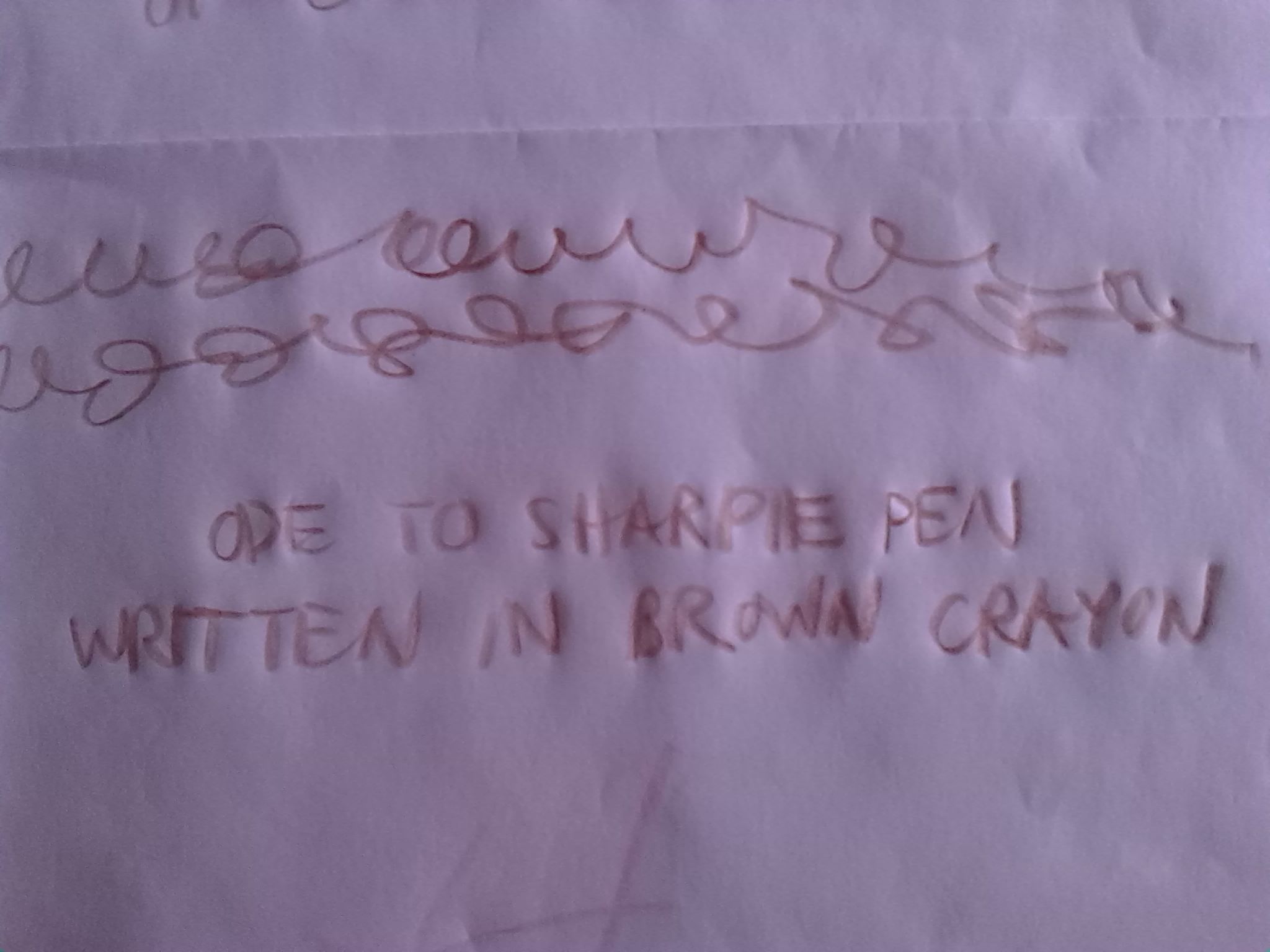
We wrote bad poetry, which included odes to phlegm, folding chairs, red leather chaps and the winning entry:

IMG_20150406_141935

If you want to write bad poetry, it’s easy: pick a thing (could be something abstract like love, or mundane like a granola bar). Write ODE TO [THING] at the top of a sheet of paper. Now write the worst poem you can about that thing.

Some techniques to try: bad rhymes, going on way too long or not long enough, stating the obvious, reveling in self-indulgence, making bad jokes, using “I” as much as possible, dragging a metaphor into the ground… there are SO MANY WAYS! Start and find out what your personal worst is.

BIG PROBLEMS / STUPID SOLUTIONS

We brainstormed stupid solutions to big problems, like racism, climate change and feeding hungry kids.

IMG_20150406_142052 (1)

You can try this too, with either a big global problem or a problem in your life. Pick the problem, set the timer for 5 minutes, and come up with as many dumb solutions as you can.

Here’s an example from my life: a problem I’m experiencing lately is how to get my 19-month-old son to sleep at night. Here are some stupid solutions:

  • I could write a 5-page essay on the merits of sleep and read it aloud to my son
  • I could perform an interpretive dance every night called “Bed Time”
  • I could walk outside in the middle of the night and cry to the heavens, “WHY?!!!!”
  • When he wakes up in the middle of the night, I could just cry with him
  • I could give him a shot of whiskey [remember, these are STUPID solutions, not things I would actually do!]
  • I could play him these ‘power of positive thinking’ tapes someone gave me
  • I could find a boring financial podcast and play that on repeat
  • I could post a question about it on facebook [full disclosure, I know this is a stupid solution because I have done it]
  • I could make flyers that say HELP ME GET MY SON TO SLEEP and post them around town with my phone number

You get the idea.

FALLING

We practiced falling, and then practiced doing a big confident walk across the room with a spectacular fall in the middle.

If you want to fall right, here’s how: count to ten, and do a slow motion fall so you’re on the ground by the time you get to ten. Then count back from ten to one, and get back up on your feet in slow motion.

Do it again, but with a five-count. Now do it to a count of 3. Look at that! You’re falling!

BAD ELEVATOR SPEECH

We ended the workshop with super awkward, meandering, oddly confrontational elevator speeches.

Want to try? Imagine someone you deeply want to impress. Someone you would love to meet and get a chance to talk to – maybe it’s a leader in your field, or the boss of your boss, or the hot guy you keep seeing around town.

Now imagine that you walk into an elevator in a building, and GET OUT OF TOWN. They are standing right there. Now is your chance!

Imagine what you would like to say to them in the two minutes you have in the elevator – the words you would use, the way your body would move, how they’d look at you.

Now stand in front of a mirror, and do the opposite of that.

Say exactly what you would NOT like to say, using words that you would not like to use, doing things with your body that are embarrassing or awkward or weird, and imagine their face looking back at you in horror.

Bonus round: do your best confident walk, and say the best version of your elevator speech, but halfway through launch your spectacular fall.

There! Doesn’t it feel good to get all that out of your system?


Hey! Want to work some of these ideas out in person? I’m available to do one-on-one sessions, or you can hire me to lead a workshop for your organization!

practice failing

Everyone knows that the way to innovate, grow and become smarter is to fail.

Fail more, fail better, fail smarter, fail wisely – experts agree that if you want to succeed, you need to be willing to fail.

Which is great. I get that, intellectually.

But how do you actually DO it?

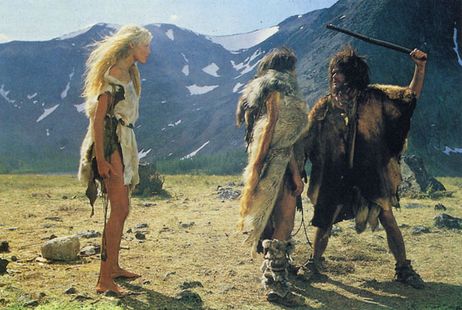
Because no matter how strongly you believe in it’s importance, or how many strong words you put next to it, the fact remains that actually failing is scary as hell. We are socially wired to avoid failure at all costs for fear of being banished from the tribe and left out in the wilderness to die (though if you find yourself in that scenario, reading Clan of the Cave Bear and asking yourself, what would Ayla do? will go a long ways towards assuring your survival).

From author Jean Auel’s website:

In Ayla’s story readers find what very well may be the story of human survival, for it is by wit, instinct, adaptation, and gathering knowledge that Ayla thrives among a people who are not like her, in a society that sees her as strange, in a world where elements, animals, and the enmity of others make surviving each day a challenge.

Anyway, point is, many of us avoid failure in high stakes situations, because when the stakes are high, you are in survival mode, and survival mode tells you it is imperative that you not fail, that you fit in, that you win. But as Ayla would tell you, this is exactly the situation when having a good relationship with your fear of failure can help you. Because here is the thing:

Failure is a potential – even likely – outcome, no matter WHAT you do.

You can’t control when and where it will rear it’s head.

What you can control is your response to it.

So for instance, if you find yourself alone with a bear and your slingshot misfires, you are in much better shape if you have experienced a misfire many, many times before. If you have only operated your slingshot (I have no idea what a slingshot is exactly or if it can misfire, but let’s stay with this metaphor anyway) under optimal conditions, then you will have no idea what to do when it doesn’t work.

It is avoidance of failure that can get you killed, and it is being on good terms with failure that can help you survive.

So, back to our original question: HOW to get on good terms with failure?

I think the way to do this is to practice failing when the stakes are low. To embrace it when you aren’t, say, starting a new job or putting your savings account on the line or moving to a brand new city.

This Sunday, I am offering space to do just that, in my “I’m the Worst” workshop.

We are going to not merely be OKAY with failure, to TOLERATE our mistakes. We are going to try our hardest to make them, in the biggest, boldest, dumbest way possible.

 We are going to celebrate failure.

We are going to fail over and over again.

We are going to see what it means to win at losing.

We aren’t going to do this because we enjoy looking like jackasses (though we might enjoy it a little bit). We are going to do this so we can encounter that fear, dance with it, and get to know it. We are going to do this so we are well acquainted with falling.

Have you ever watched a baby learn how to walk? There is a LOT of falling involved. Like way more than seems reasonable. A lot of tipping over and lurching and bumping into things and tripping and getting stuck. And then, slowly, they learn how to balance their weight, how to right themselves, how to measure their footsteps, when to jump and when to shuffle, how to recover their balance gracefully – how not to fall.

That is what we are going to do! Spend two hours falling and failing. (And if you can’t be there in person, you can play along at home by failing at something low-stakes this week and seeing how it feels. You could tell a bad joke at a party. You could wear an ugly outfit around the house. You could wear it out dancing. You could dance like Elaine. The options are limitless.)

Then maybe next time we find ourselves in a high stakes situation, we can go into it thinking, hey, I’ve failed before, it’s not so bad.

I’m going to spend two minutes being awkward at this party and then I’m going to find someone I like talking to and we will hit it off.

I’m going to sweat too much, talk too fast and make a dumb joke in this job interview, and then I’m going to ask some good questions and show them I know what I’m talking about.

I’m going to spend 6 weeks (or months) having nightly panic attacks in my empty apartment and going to random coffee shops and the wrong bars before I find the right ones and figure out where my people are.

See what I mean? If you’re ready for it, it’s a little less scary. If you’ve experienced flop sweat and survived, you know it’s not as life threatening as you think it is.

So let’s do this!

Scene-from-the-film-version-of-Clan-of-the-Cave-Bear

Being Confident, part I: what does it mean

Confidence is a word that fascinates me.

It seems to fascinate everyone. It’s almost impossible to read anything self-help oriented without someone telling you to BE CONFIDENT! (The other thing you should always do is BE YOURSELF – if your real self is not confident, I guess you’re shit out of luck).

So I thought maybe we could break down the word confidence and see what’s behind it, since we’re all so in love with it.


CONFIDENCE = with strength

 = sureness

 = sure grasp of situation, facts

 = comfortable in your skin

 = leader

 = charismatic

 = fortress – unbreakable – impenetrable

 = armor = projecting an image of strength = invulnerable

 = secrecy — sharing a secret in confidence — a confidante

 = trust — you have the trust of others

 = con man (literally a confidence man) – a professional liar, a swindler


A few interesting things here:

Confidence is an action, an exchange – the act of confiding or being confided in – a transaction between people, not a static state.

Confidence is conferred upon you by others. You inspire confidence, which means you inspire others to trust you.

When people give you their trust, they are opening themselves up to potential danger. They have confidence in you, but they also know that you could take advantage of them.

Here’s another way of thinking about it: we trust someone who is holding down the fort, because we have to. We don’t want someone guarding the gates who will fumble with the arrows. But we also know that no one has 100% sure aim. And so when we put our trust in someone, we are also acknowledging our dependence on them, which is an inherently risky state.

Confidence is also something that we project outward about ourselves in order to protect our vulnerable real selves.

And yet by projecting a fortress of strength, we are by nature projecting a false reality, which we know is false. We know that we are not in fact infallible and inviolable.  So we are depending on this fortress of certitude to protect us, and simultaneously doubting it’s strength.

This is very interesting!

It suggests that confidence and doubt are much more intertwined than we think.

Which makes sense to me. I always find it strange when someone tells me to be more confident, because I feel confident, even when I’m in the grips of the strongest self-doubt. Seeing it through this lens, I realize that when someone tells me to be more confident, what they’re saying is, I don’t trust you.

Hmmm. Is this true, or did I just fall down a word association rabbit hole? I’ve got more to say about this, but it will have to wait for next time.

Justin thinks she’s confident (I think this song is terrible)

Try this: A VISUAL SYLLABUS

Today as I was dreaming up the trajectory for the next round of the Creative Workout Group (there are still spots open if you want to sign up! I would love to have you there) I got the idea to make a visual syllabus.

I taped a big piece of paper on the wall, wrote the numbers 1-6 (one for each class), wrote the big themes we’d cover under each number, and then drew a picture for each.

IMG_20150310_131235It was so much fun and I highly recommend it if you’re trying to figure out the big scope of a project.

  • Write the name of your big thing at the top of a big piece of paper
  • Divide the big thing into chunks — could be classes, chapters, months, weeks, hours, years
  • Write the names / numbers of the chunks on the paper
  • Draw what will happen in each chunk of time (the word ‘chunk’ is unfortunate but I’ve chosen it and I’m sticking with it)
  • If you want, write action steps, exercises, reading to be done under the drawing. In my case it’s a breakdown of how each class will go — the structure, the exercises we’ll use and any relevant reading material.

I love the one I made because it gives me visual pleasure, which helps keep me connected to why I’m doing this, what I love about it and how it fits into my big picture.

On not praising, not giving advice, and drawing your feelings

I’ve been reading the book How to Talk So Kids Will Listen & Listen So Kids Will Talk in preparation for the approach of (duh duh DUHHHHH) the toddler state.

IMG_20150218_171723

What, me tantrum?

It’s a fantastic book, and what’s fascinating is how much of their advice about how to communicate with kids applies just as well to adults.

In particular, these three techniques struck me – I notice myself using them in sessions as a creative guide, and I think they are wonderful tools we can all use to communicate better.

1) Unhelpful vs. helpful praise

As they put it, “praise can be tricky business. Sometimes the most well-meant praise brings about unexpected reactions.”

In particular, these reactions:

  • Praise can make you doubt the praiser.
  • Praise can lead to immediate denial.
  • Praise can be threatening.
  • Praise can force you to focus on your weaknesses.
  • Praise can create anxiety and interfere with activity.
  • Praise can also be experienced as manipulation.

What works far better is “helpful praise”, which is descriptive rather than evaluative.

“If you describe with appreciation what you see or feel, the child, after hearing the description, is then able to praise himself.”

The problem with words that evaluate – good, beautiful, smart, awesome – is that they draw attention to your judgment as the praiser, instead of the person or thing you’re praising.

So if I say, Wow, what a beautiful painting, you are likely to think, She’s bullshitting me, or Jeez, she thinks that’s beautiful? or I don’t think it’s beautiful at all, or What’s she going to think of the next one… etc etc etc. But you are not likely to think, My painting is in fact beautiful.

On the other hand, if I focus on what I see and feel in response to the painting, you can decide for yourself what to do with that information.

I could say, I see a lot of color in this painting. Or, This painting reminds me of a field I used to run in as a kid. Or, I love the way the paint is layered on the canvas.

Do you see the difference? One is an evaluation and stops the conversation – one opens the door to a larger conversation that is much more interesting than good job/bad job.

2) The futility of giving advice

“When you give immediate advice to children, they either feel stupid (‘Why didn’t I think of that myself?’), resentful (‘Don’t tell me how to run my life!’), or irritated (‘What makes you think I didn’t think of that already?’). When a child figures out for herself what she wants to do, she grows in confidence and is willing to assume responsibility for her decision.”

I think the exact same thing is true of adults. And what they recommend doing instead is this:

  • Help her sort out her tangled thoughts and feelings.
  • Restate the problem as a question. (They also suggest that you “keep quiet after you’ve asked a question like this. Your silence provides the soil in which the child’s solutions can grow.”)
  • Point out resources your child can use outside the home.

The more I think about it, this book is basically a manual for being a Creative Guide. I can’t think of a better description for how I work with people than those three things.

3) The usefulness of drawing your feelings

“… the one activity that seems most comfortable for parents to watch, and most satisfying for children to do, is to draw their feelings.”

They describe this scene between a mother and her 3-year-old:

“’I knelt down, handed the pencil and pad to Joshua, and said, ‘Here, show me how angry you are. Draw me a picture of the way you feel.’ Joshua jumped up immediately and began to draw angry circles. Then he showed it to me and said, ‘This is how angry I am!’

I said, ‘You really are angry!’ and tore another piece of paper from the pad. ‘Show me more,’ I said…. When I handed him a fourth piece of paper, he was definitely calmer. He looked at it a long time. ‘now I show my happy feelings,’ he said.

How interesting that we as adults would rarely think of doing this!

Can you imagine? Next time you and your partner / mother / best friend / co-worker get into a fight, imagine saying this:

Hey, partner.

You seem frustrated. Can you draw your feelings for me?

Wow, that IS frustrating!

I am frustrated too, can I draw what I’m feeling for you?

I am going to start using this as a conflict resolution tool and see if it works! I’ll report back, and if you try it, let me know how it goes.

I also love the cartoons in the book to demonstrate what to do and not to do, like this:

The anti-to-do list

Our first Creative Workout Group has wrapped up, and I am sad to see it end. (But I am excited for another round to start next week!)

We ended by coming up with alternatives to the dreaded to-do list, which included:

  • The trail map timeline: come up with a KEY for your project and mark the time-trail on the page (preferably with crayons)
  • The visual icon / talisman board: track your project through symbols and containers for relevant objects (hard to describe but highly inspiring)
  • Brian Eno’s oblique strategies: make a set of cards with the things you have to do, and draw one at random. I can’t tell you how much I LOVE this idea.
  • The don’t-do list (the jury is out on whether or not this would work): make a list of what you do not want to do, and don’t do it (or if you’re a born rebel, do it).

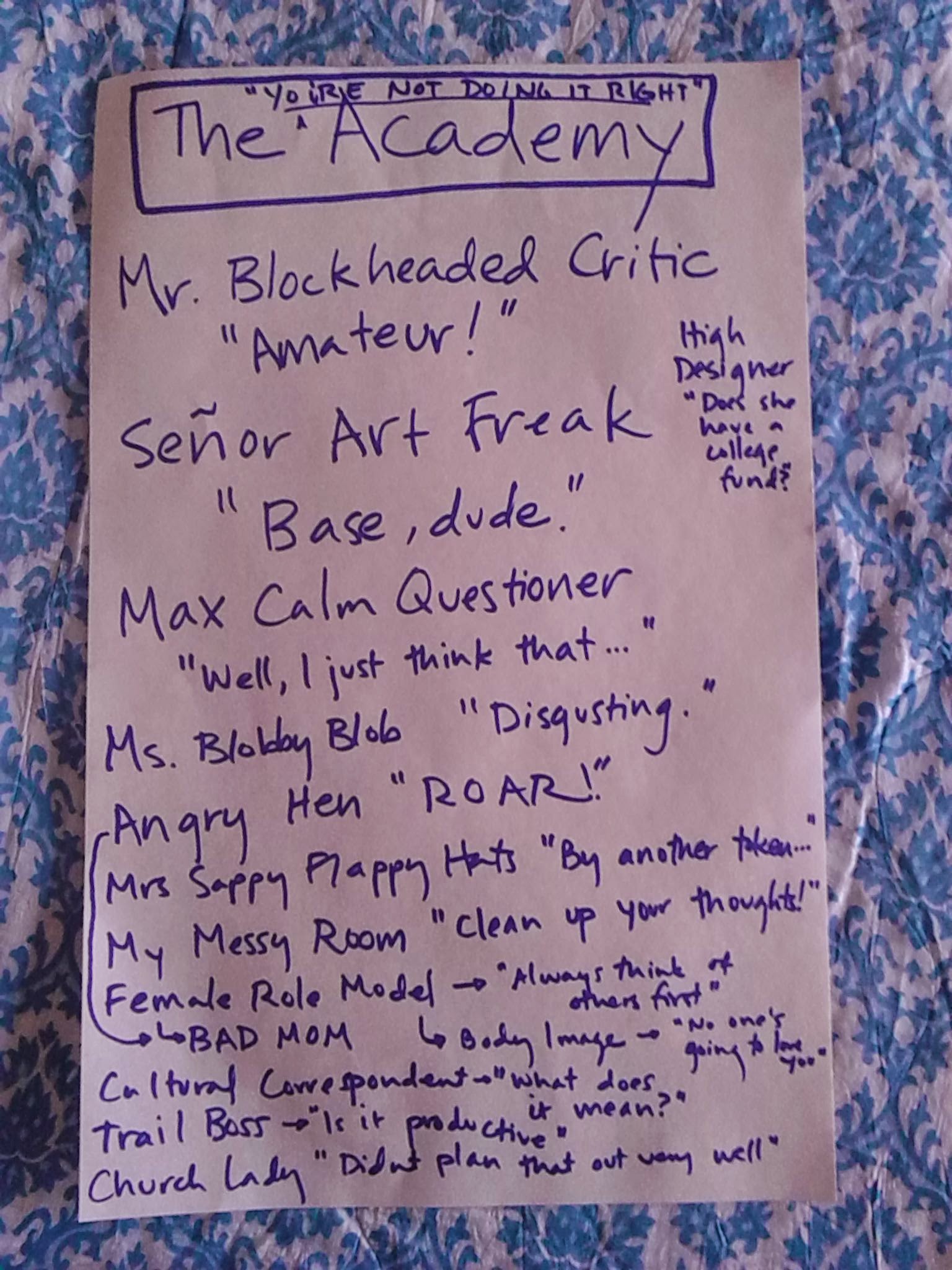
We also reflected on what we discovered together, including our academy of critics — not included on this list below is a late addition, and one of my personal favorites, the Iconoclast Curator (he is very concerned as to your status as an original thinker and whether or not you are HOT SHIT):

IMG_20150127_121708

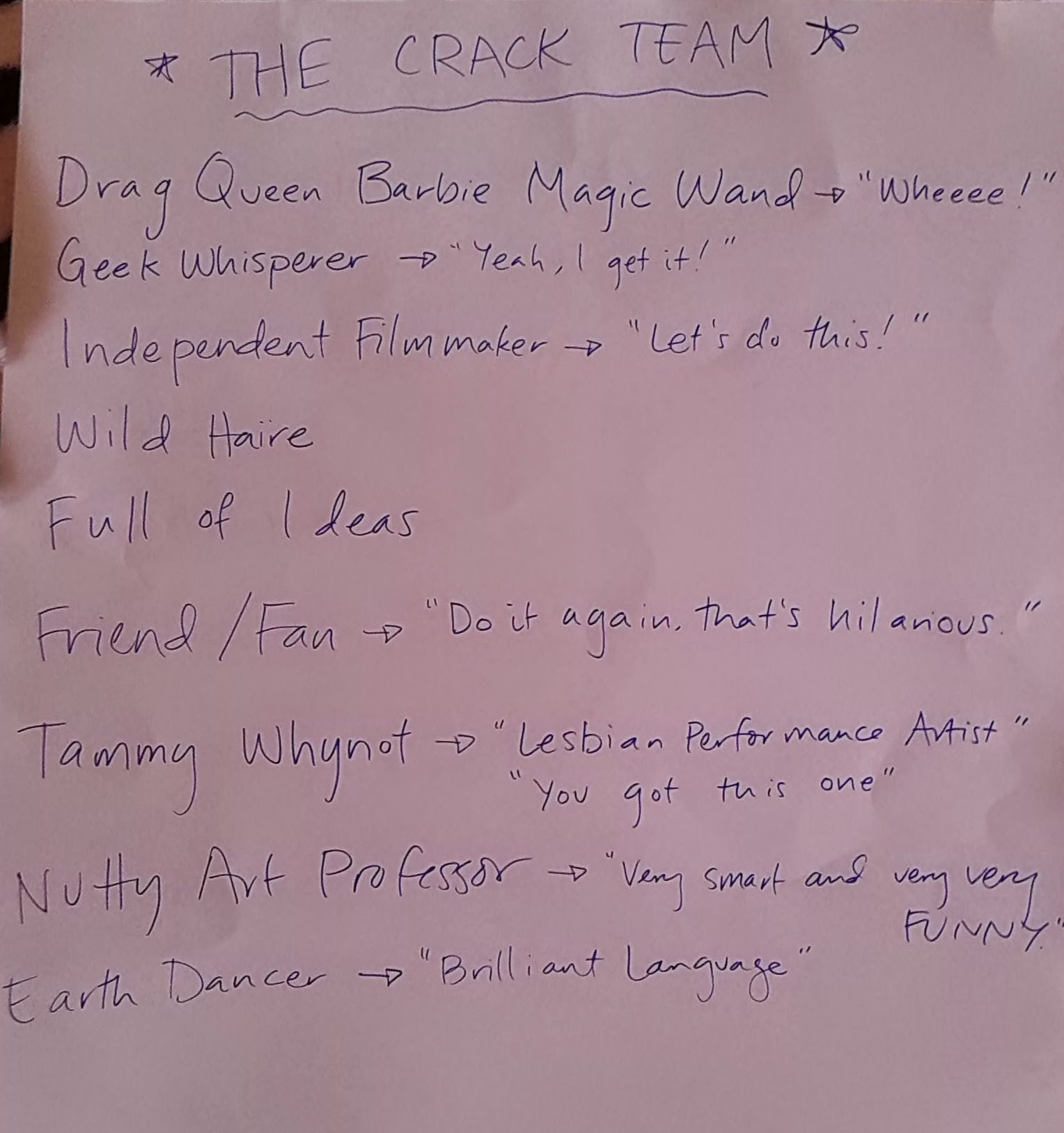
…and our crack team of champions:

IMG_20150203_123445

Boasting practice (part 1)

In this week’s Creative Workout Group, we took all the work we’ve done identifying critics and champions, and used it to start developing material to boast about ourselves and our accomplishments.

This is surprisingly (or not surprisingly, I guess) hard to do, and everyone was nervous about it.

But we took it slow, and by the end we were cracking each other up and feeling inspired. It sounds paradoxical, but I think the key to learning to boast about yourself is:

  1. Not taking yourself too seriously.
  2. Focusing on where you’ve been and the hardships you’ve overcome (not just how good you have it now).
  3. Setting the stage with anything that helps you feel powerful, including props, shoes, a fabulous pantsuit or haircut (speaking of which, I LOVE this video I just came across from Lucky Bitch – and I say this as someone who spends zero effort and money on my hair), and most importantly, the right backing music.

So, in part one of an ongoing series about how to ease into boasting about yourself, I offer you some inspiration from the masters:

Nicki Minaj, “I’m the Best”

Muhammad Ali — man, I could watch videos of him all DAY:

See if this inspires you to talk about what you’ve overcome and what a badass you are.

And if you want to take that inspiration further, put on one of these backing tracks and get some practice!


By the way – if you’d like to join a Creative Workout Group, we have a new one starting on March 3! I’m also offering a free Creative Work Out Zone workshop the first Sunday of every month, starting March 1 — RSVP here.

Try this: Identify your champions

Last week in the Creative Workout Group, we put names to our critics — this week we went in the other direction, and identified our champions.

If you would like to identify some champions rattling around in your head, try this (and warning: don’t let your critic stop you! If he/she keeps getting in the way, get out a separate sheet of paper and write down whatever they say there, to be addressed later).

1) Get some things down on paper — don’t worry about answering all of these, use any that get the ideas flowing and skip the rest.

  • Write down anything positive that is running through your head about yourself right now.
  • Think back over the week until you hit on something that you feel proud of. What did you say to yourself when it happened? What did other people say to you about it?
  • List all the compliments paid to you this week.
  • What would you like people to say about you? What would you like to say about yourself?
  • Think about someone you saw this week who you admire. What did you admire about them? What did you say to them (out loud or in your mind)?
  • Fill in the blank:

I am at my best when I _____.

I have always been good at _____.

I really know how to _____.

I wish I could spend all my time _____.

___ is one of my greatest strengths.

2. Go down the list and for each phrase, jot down any associations that arise:

  • Can you hear someone saying it? Is it someone you know? Does it remind you of someone, real or fictional?
  • What does the person saying it look like?
  • What qualities does their voice have?
  • Do images or objects come to mind?

3. Write associations down on a new sheet of paper.

  • Take a look at them. Are there different camps or are they all a variation on the same thing?
  • Group them together or separate as needed.

4. Give each group a name and a catchphrase. 

  • As with the critics, this can be a descriptive alias, a random strong name, a job title or mark of authority, or it might be right there in your list of associations.
  • Give them a catchphrase — something that they say often, or that embodies their spirit or sums them up for you.
  • And now if you want to get really warm and fuzzy, write those names and catchphrases on a big sheet of paper in sparkly markers and give them a team name. The one our Creative Workout Group came up with for our collective champions yesterday was The Crack Team.

When I did this exercise for myself the other day, four different champions emerged. I’m calling them the Breakfast Club:

Gruff Teacher → “I’m proud of you.”
Excited Little Sister → “Wow, you’re doing this!” or “It’s WORKING!”
Calm Clear Girl → “You’re weird. I like you.”
Wild Freestyler → “I’m the Best!

 See what emerges in your champion world!


Want to delve deeper? Sign up for a session and we can work together one on one — the first one is free!